Industry News
Curation by industry experts
Hot Articles
- Eco-Refrigerant & ComplianceLow-GWP Refrigeration for Supermarkets: How to Compare CO2, R290, and HFO Options
- Cold Chain & Retail Energy InsightsCold Storage Warehouse Solutions: How to Size Capacity, Temperature Zones, and Energy Loads
- Thermodynamic Tech TrendsHow to Size Heat Exchange Systems for Refrigeration Plants at Peak Load
Popular Tags
Chinese Customs updates ice machine export declaration requirements
On August 13, 2026, the General Administration of Customs of China issued an announcement on strengthening the export declaration management of commercial ice-making equipment, requiring flake ice machines and tube ice machines to truthfully declare the refrigerant type and accurate charging amount during export declaration, and simultaneously submit relevant test reports issued by CNAS certified laboratories. For export companies, customs declaration links and testing service chains facing markets such as the EU, South Korea and Saudi Arabia that have implemented F-Gas or local low-carbon refrigeration rules, this is not a simple document supplement, but a signal that customs clearance, access and delivery arrangements need to be adjusted simultaneously.
Customs declaration information begins to be directly related to refrigerant compliance
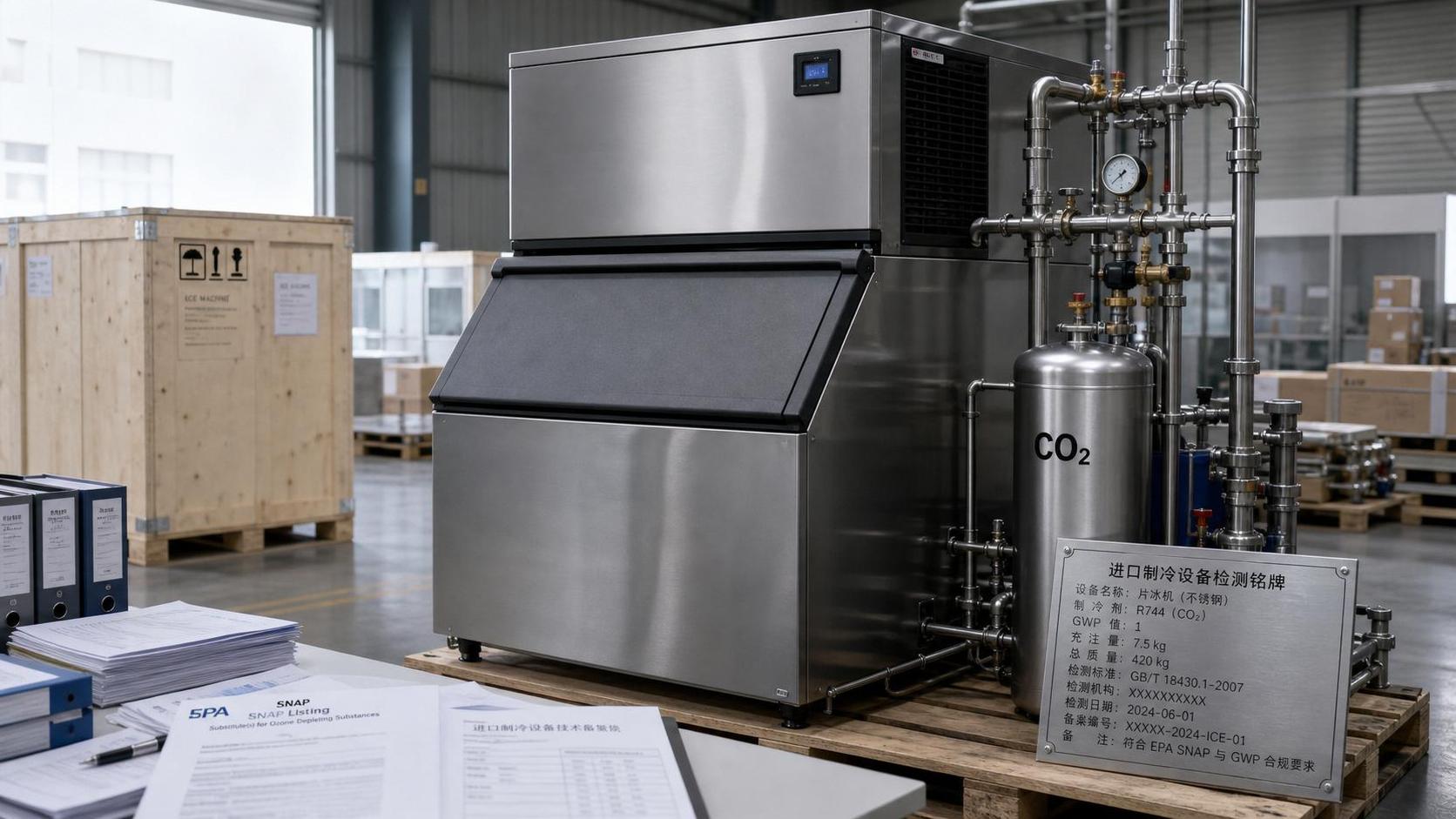
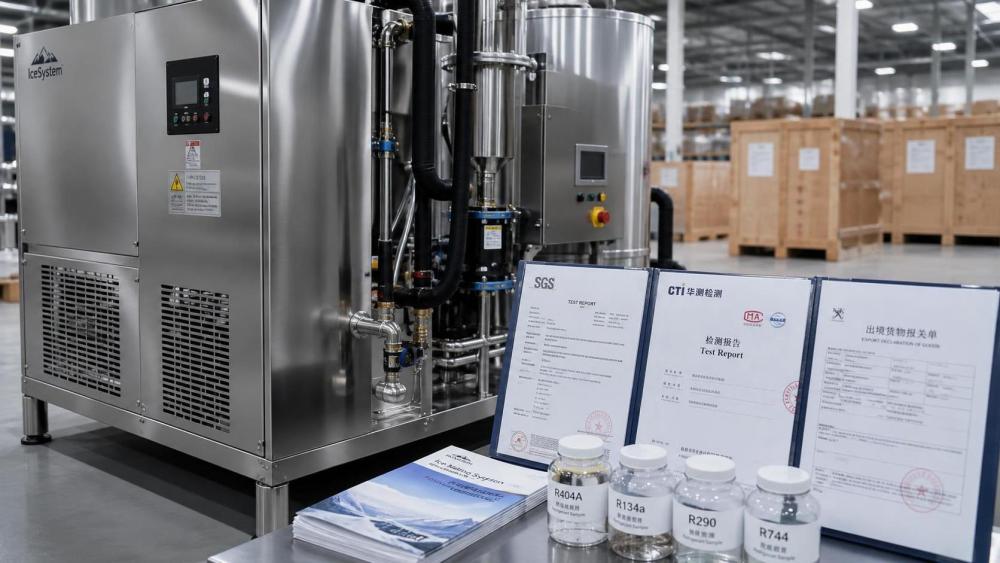
According to the announcement, from now on, all exported flake ice machines (Flake Ice Machines) and tube ice machines (Tube Ice Machines) need to truthfully fill in the type of refrigerant used in the customs declaration form, such as R290, R744/CO₂, R513A, etc., and indicate the precise filling amount (kg). The announcement also requires the simultaneous uploading of refrigerant compatibility and leakage rate test reports issued by CNAS certified laboratories.
This means that export declarations no longer just stay at the level of equipment name, quantity and basic specifications, but bind refrigerant information, testing materials and customs declaration actions into the same set of compliance chains. Judging from the known information, this requirement is directly related to F-Gas or local low-carbon refrigeration rules in markets such as the EU, South Korea, and Saudi Arabia, and its impact focuses on customs clearance efficiency and compliance access.
Which links will feel the changes first
Export enterprises need to move the declaration standard forward to technical information
For companies that directly export flake ice machines and tube ice machines, the impact is first reflected in the preparation of customs declaration documents. The type and filling amount of refrigerant must be consistent with the actual product, which requires companies to maintain consistency between order confirmation, model configuration, factory information and customs declaration information, otherwise it is easy for information mismatches to occur during the declaration process.
If the product is targeted at multiple markets at the same time, companies also need to pay attention to whether there are different refrigerant configuration versions of the same model. From an analysis point of view, such differences may have been more reflected in the sales specification sheet in the past, but now they will further enter the export document management.
The role of relevant testing and certification agencies is magnified
The announcement clearly mentions the refrigerant compatibility and leakage rate test report issued by the CNAS certified laboratory. This makes the test document no longer just an internal quality data, but a key attachment in the export declaration chain. For testing service agencies, certification-related companies and teams responsible for type verification, the report format, test items, sample consistency and issuance time will directly affect whether the company can declare customs as planned.
What deserves more attention now is whether the company has established a consistency mechanism from research and development, testing to customs declaration document archiving. Without this mechanism, document corrections will often be transmitted to the delivery cycle.
Procurement and delivery for the compliance market will pay more attention to the completeness of documents
For purchasers and channel circulation links, this change will further extend "whether the equipment itself meets the requirements" to "whether the equipment can be successfully cleared and delivered in the destination country." Especially in markets such as the EU, South Korea, and Saudi Arabia that have implemented relevant low-carbon refrigeration rules, the completeness of documents may directly affect the order delivery pace and post-arrival processing efficiency.
From an industry perspective, the connection between procurement documents, technical specifications and shipping materials will be more important than ever. If the refrigerant configuration and testing document requirements are not confirmed in the front-end procurement stage, the back-end delivery will easily bear additional communication costs. ZXTAG32ZZ As far as this announcement is concerned, the most important thing is not to add a general description, but to require that specific data be filled in.
Test reports must be managed synchronously with the shipment batches
Since the announcement clearly requires the uploading of CNAS certification laboratory reports, companies need to pay attention to whether the reports cover the corresponding models, configurations and batches. If there are differences in refrigerants or processes between different batches, whether the relevant documents can be matched one by one is the key to the smooth progress of subsequent declarations.
Compliance requirements in key markets must be embedded in the sales process in advance
For markets that have implemented F-Gas or local low-carbon refrigeration regulations, companies cannot just supplement materials at the declaration point, but should confirm the data requirements in advance during order receiving, selection, certification, testing and shipping. The focus of this is not to increase the process, but to avoid information gaps during the customs clearance stage.
Internal compliance standards should be unified into the same set of documents
For enterprises involved in R&D, production, foreign trade and customs declaration, it is recommended to unify refrigerant information, test conclusions and export declaration fields into the same set of controlled documents. This can reduce the risk of customs declaration rework, customer doubts or delivery delays caused by version inconsistencies.
This is more like an execution signal than an abstract statement
From an analysis point of view, this information is more suitable to be understood as a rule change that has entered the execution level, rather than staying in a directional statement. Its focus is not on discussing the general trend of low-carbon refrigeration, but on clearly incorporating the refrigerant type, charging amount and CNAS test report into the export declaration requirements.
However, it is still necessary to continue to observe the specific execution caliber, document details, how different models correspond to the declaration fields, and whether it will be extended to more categories or markets in the future. In particular, the customs declaration feedback, testing connection and market access changes encountered by enterprises in actual enforcement will affect the enforcement of this requirement in the industry.
The most suitable way to understand it at present
Judging from the current information, this is not a notice that only affects customs declaration documents, but more closely ties together the technical parameters, testing materials and regulatory declarations for the export of commercial ice-making equipment. For relevant companies, what really needs to be adjusted is not a single form, but the entire data chain from R&D selection, testing arrangements to export declaration.
Therefore, it is currently more suitable to understand it as a clear compliance enforcement signal: the rules have been directed to the front end, and the follow-up focus will depend on how the company synchronizes product configuration, test reports and trade documents, and what kind of feedback will be generated in the actual customs clearance process.
Public information based on this article
This article is generated based on the information title, event time and event summary provided by the user. Such events are usually associated with customs department announcements, regulatory agency releases, trade authority information, industry association materials, standards organization documents and authoritative media reports. No specific official source link is provided in the input, and it is still necessary to continue to verify the full text of the announcement, enforcement standards, certification requirements, changes in relevant bidding documents, and industry feedback.
Recommended News
 Flake Ice MachinesWhy Some Commercial Ice Machines Cost More After InstallationAnalyst :Commercial Ice Tech Fellow
 Flake Ice MachinesFlake Ice Machines vs Other Ice Types for Fast Heat RemovalAnalyst :Commercial Ice Tech Fellow
 Flake Ice MachinesWhat affects flake ice production more than output specs?Analyst :Commercial Ice Tech Fellow
 Flake Ice MachinesYuyao Cool Appliances Export Up 70%; Ice Cream Machines in 100+ Countries Under RCEP Zero TariffAnalyst :Commercial Ice Tech Fellow
 Flake Ice MachinesFlake ice machines or tube ice for faster cooling?Analyst :Commercial Ice Tech Fellow
 Flake Ice MachinesHow to improve flake ice production without bigger power useAnalyst :Commercial Ice Tech Fellow
 Flake Ice MachinesHow to choose industrial ice makers for steady outputAnalyst :Commercial Ice Tech Fellow
 Flake Ice MachinesWhy flake ice production often fails at peak demandAnalyst :Commercial Ice Tech Fellow
 Flake Ice MachinesHow industrial ice makers affect uptime and ice qualityAnalyst :Commercial Ice Tech Fellow
 Flake Ice MachinesWhy flake ice production fails quality checks so oftenAnalyst :Commercial Ice Tech Fellow
 Flake Ice MachinesWhat size flake ice machines fit daily production?Analyst :Commercial Ice Tech Fellow
 Flake Ice MachinesWhat affects the cost of commercial ice machines?Analyst :Commercial Ice Tech Fellow
 Flake Ice MachinesAre flake ice machines worth it for concrete cooling?Analyst :Commercial Ice Tech Fellow
 Flake Ice MachinesCommercial Ice Machines: How to Size Capacity, Storage, and Water UseAnalyst :Commercial Ice Tech Fellow
![]() Flake Ice MachinesCommercial Ice Machines Buying Guide: Ice Type, Output Capacity, and Water QualityAnalyst :Commercial Ice Tech Fellow
Flake Ice MachinesCommercial Ice Machines Buying Guide: Ice Type, Output Capacity, and Water QualityAnalyst :Commercial Ice Tech Fellow![]() Flake Ice MachinesMiddle East Air Cooler Exports Rise 25% as Flake Ice Demand FollowsAnalyst :Commercial Ice Tech Fellow
Flake Ice MachinesMiddle East Air Cooler Exports Rise 25% as Flake Ice Demand FollowsAnalyst :Commercial Ice Tech Fellow![]() Flake Ice MachinesHow to Choose Industrial Ice Makers for Food Processing and Cold StorageAnalyst :Commercial Ice Tech Fellow
Flake Ice MachinesHow to Choose Industrial Ice Makers for Food Processing and Cold StorageAnalyst :Commercial Ice Tech Fellow![]() Flake Ice MachinesIce-Making Equipment Types and Key Specs: What Matters for Plant Operations?Analyst :Commercial Ice Tech Fellow
Flake Ice MachinesIce-Making Equipment Types and Key Specs: What Matters for Plant Operations?Analyst :Commercial Ice Tech Fellow Flake Ice MachinesHow to Choose Commercial Ice Machines for Restaurants, Bars, and Convenience StoresAnalyst :Commercial Ice Tech Fellow
 Flake Ice MachinesHormuz Shipping Disruption Delays Flake Ice Machine PartsAnalyst :Commercial Ice Tech Fellow
 Flake Ice MachinesPakistan Cuts Duties on Reefer Imports, Easing Flake Ice LogisticsAnalyst :Commercial Ice Tech Fellow
 Flake Ice MachinesPakistan Cuts Duty on Reefer Containers for Ice LogisticsAnalyst :Commercial Ice Tech Fellow
 Flake Ice MachinesFlake Ice Machines Buying Guide: Output Capacity, Ice Thickness, Materials, and MaintenanceAnalyst :Commercial Ice Tech Fellow
 Flake Ice MachinesCommercial Ice Machines for Restaurants and Bars: Types, Output, and Drainage NeedsAnalyst :Commercial Ice Tech Fellow
 Flake Ice MachinesFlake Ice vs Tube Ice-Making Equipment: Which Fits Food Processing Better?Analyst :Commercial Ice Tech Fellow
 Flake Ice MachinesCommercial Ice Machines Explained: Types, Ice Output, and Best Uses by BusinessAnalyst :Commercial Ice Tech Fellow
 Flake Ice MachinesEPA Rule 72 Extends R-404A Deadline for Flake Ice MachinesAnalyst :Commercial Ice Tech Fellow
 Flake Ice MachinesEPA Extends R-404A Flake Ice Machine Exemption to Q1 2028Analyst :Commercial Ice Tech Fellow
 Flake Ice MachinesEFTA Customs Require QR Trace Labels on Flake Ice MachinesAnalyst :Commercial Ice Tech Fellow
 Flake Ice MachinesHow to Choose a Flake Ice Machine Drum: Capacity, Material, and Ice Quality FactorsAnalyst :Commercial Ice Tech Fellow
 Flake Ice MachinesGCC Tightens Import Rules for Flake Ice MachinesAnalyst :Commercial Ice Tech Fellow
 Flake Ice MachinesEPA Expands GWP Filing Scope for Flake Ice MachinesAnalyst :Commercial Ice Tech Fellow
![]() Flake Ice MachinesEPA Expands GWP Filing Scope for Flake Ice MachinesAnalyst :Commercial Ice Tech Fellow
Flake Ice MachinesEPA Expands GWP Filing Scope for Flake Ice MachinesAnalyst :Commercial Ice Tech Fellow Flake Ice MachinesEPA Expands GWP Filing to CO2-Assist Flake Ice MachinesAnalyst :Commercial Ice Tech Fellow
 Flake Ice MachinesVietnam VAT Waiver Opens Flake Ice Machine Import WindowAnalyst :Commercial Ice Tech Fellow
 Flake Ice MachinesIndia Raises Flake Ice Machine Import Duty to 12.5%Analyst :Commercial Ice Tech Fellow
 Flake Ice MachinesHow to Evaluate a Large Scale Ice Making Equipment Factory for Output and ReliabilityAnalyst :Commercial Ice Tech Fellow
 Flake Ice MachinesIndia Tightens Flake Ice Machine Import DocumentationAnalyst :Commercial Ice Tech Fellow
 Flake Ice MachinesThailand, Vietnam and Indonesia Ease Label Rules for Flake Ice MachinesAnalyst :Commercial Ice Tech Fellow
 Flake Ice MachinesHow to Evaluate a Large Scale Ice Making Equipment Exporter Before Bulk OrdersAnalyst :Commercial Ice Tech Fellow