Industry News
Curation by industry experts
Hot Articles
- Thermodynamic Tech TrendsHow to Size Heat Exchange Systems for Refrigeration Plants at Peak Load
- Parallel Compressor RacksHow to Size Reciprocating Compressors for Cold Storage Load and Temperature Range
- Flake Ice MachinesHow to Size a Commercial Ice Dispenser for Peak Demand in Foodservice Operations
Popular Tags
Vietnam Tightens Tube Ice Machine Entry Rules
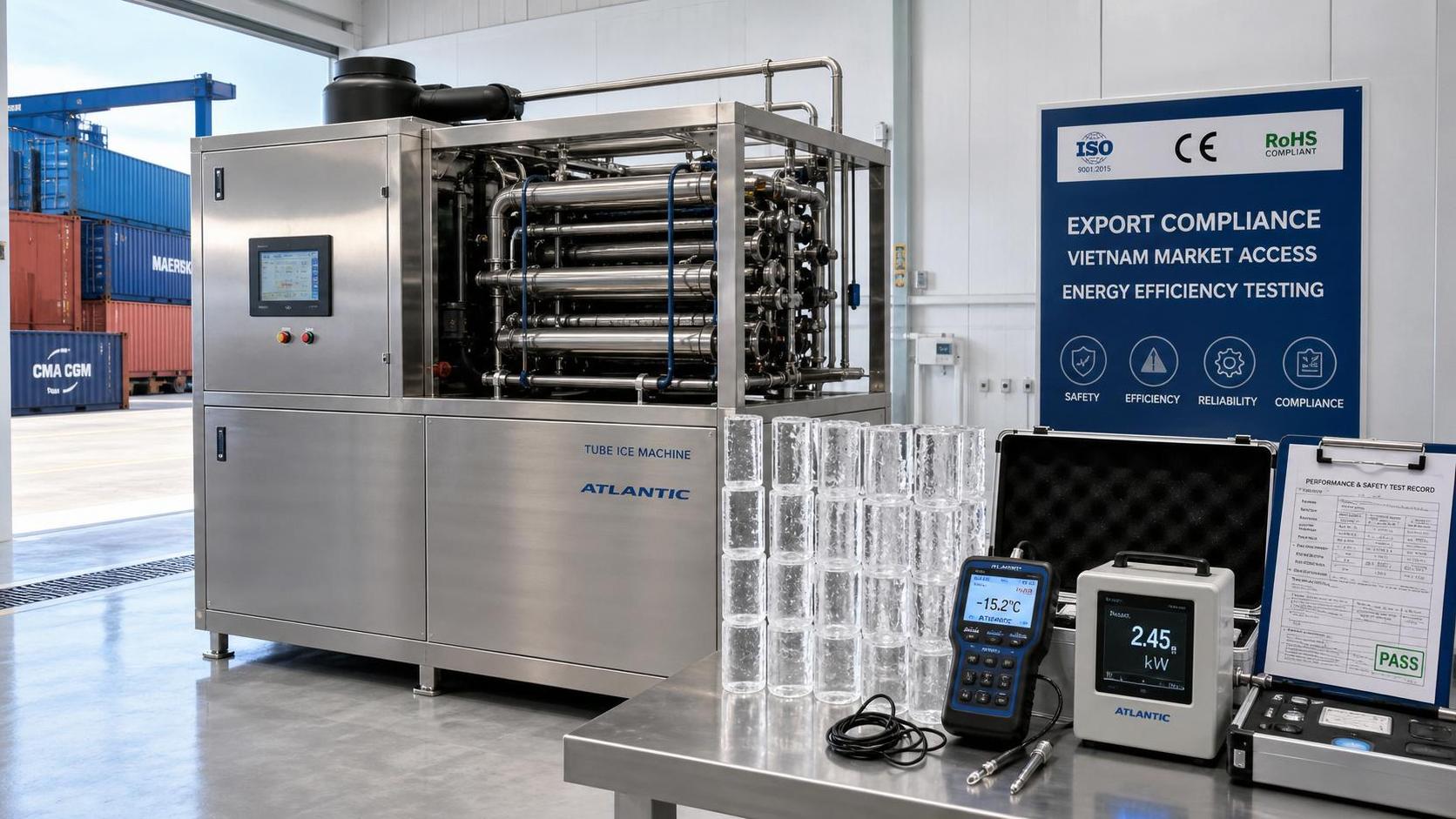
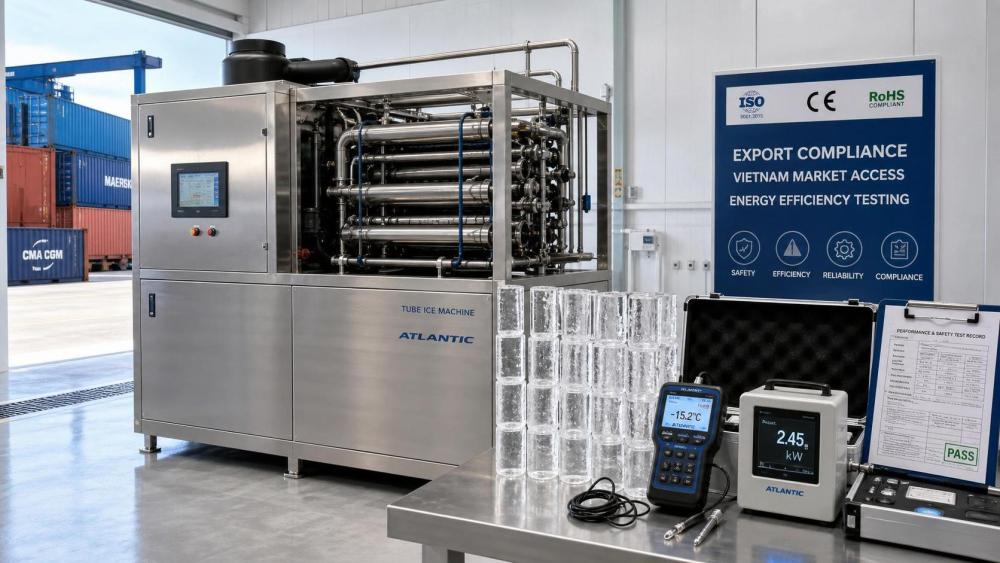
On July 12, 2026, the Southeast Asia Cold Chain Alliance (SEACLA) announced a new compliance requirement for Tube Ice Machines shipped to Vietnam: from September 1, 2026, relevant products must pass AS/NZS 4447:2026 energy efficiency testing or face rejection by Ho Chi Minh City customs. For exporters, equipment manufacturers, importers, and supply chain service providers, the development is worth close attention because it links market access not only to energy consumption, but also to a newly mandated physical ice-shape parameter within a compulsory certification framework.
What the New Requirement Specifically Says
According to the information provided, SEACLA stated on July 12, 2026 that all Tube Ice Machines exported to Vietnam will need to pass AS/NZS 4447:2026 testing starting on September 1, 2026.
The stated test conditions include an ice-shape density threshold of at least 0.92 g/cm3 and unit ice-making energy consumption of no more than 125 kWh/ton.
The same information also states that shipments failing to meet this requirement will be refused by Ho Chi Minh City customs.
Another confirmed point is that this standard, for the first time, brings a physical ice-form parameter into a mandatory certification system.
Where the Pressure May Appear First in the Chain
Export transactions may face a stricter pre-shipment gate
From an industry perspective, direct trading companies are likely to feel the impact first because the rule is tied to customs acceptance. The immediate business effect may appear in shipment qualification, document readiness, and the timing of export execution. What deserves closer attention is whether each order intended for Vietnam can clearly demonstrate compliance before dispatch.
Manufacturing decisions now connect more directly to test outcomes
Analysis shows that equipment manufacturers may be affected through product configuration, testing preparation, and technical verification workflows. Because the requirement covers both energy consumption per ton and ice-shape density, compliance attention may extend beyond nominal machine capacity and into the measurable output characteristics of the ice produced.
Importers and buyers may need tighter supplier screening
For importers, distributors, and procurement-side participants serving the Vietnam market, the issue is likely to center on supplier qualification and delivery certainty. Observably, a machine that cannot clear the required test standard introduces a direct risk to customs acceptance, which makes pre-purchase verification more important than routine commercial comparison alone.
Logistics and service partners may be pulled into compliance coordination
Supply chain service providers may also be affected at the coordination level. The rule may change how forwarders, documentation teams, and after-sales support partners prepare for delivery schedules, handover timing, and communication around acceptance conditions. The practical concern is less about transport itself and more about whether every compliance-related step is synchronized before cargo reaches the port of entry.
What Companies Should Watch Now
Distinguish the effective date from the preparation window
Analysis shows that the most immediate operational issue is the gap between the announcement date and the September 1, 2026 enforcement date. Companies involved in Vietnam-bound business should pay close attention to how current pipelines, pending quotations, and scheduled deliveries align with that timeline.
Check whether existing product documents match the new gatekeeping logic
What deserves closer attention is that the rule is framed around a specific certification outcome rather than a general performance claim. Businesses should therefore review whether their existing technical files, test records, and product communication materials are sufficient for a requirement that combines energy-efficiency metrics with a physical ice-form parameter.
Pay special attention to customs-facing documentation risk
Because the stated consequence is refusal by Ho Chi Minh City customs, companies should treat document completeness and consistency as a practical risk area. Observably, this is not only a technical question for engineering teams; it also affects commercial, compliance, and shipping functions that need a shared understanding of what must be presented before delivery.
Keep watching for any clarifying language around implementation
From an industry perspective, the announcement creates a clear headline rule, but companies should continue monitoring for any further official wording or implementation detail connected to testing, certification presentation, or enforcement practice. That distinction matters because policy wording and day-to-day execution are not always identical in cross-border trade operations.
Why This Looks Like More Than a Routine Testing Update
Observably, the most notable feature of this development is not only the energy threshold itself, but the fact that a physical ice-shape parameter has been brought into mandatory certification. Analysis shows that this can be read as a signal that product access requirements may be moving closer to measurable output quality, rather than staying limited to conventional equipment-level efficiency claims.
It is more appropriate to understand this as a concrete short-term compliance change with a possible longer-term regulatory signal. The immediate result is clear for exporters targeting Vietnam after September 1, 2026. The broader meaning, however, still requires observation because the provided information does not establish whether similar approaches will extend to other products, ports, or markets.
How to Read the Development at This Stage
At this stage, the announcement should be read as an actionable market-access requirement for Tube Ice Machines entering Vietnam, rather than as a general industry talking point. Its direct relevance lies in export readiness, customs risk, and certification alignment. At the same time, a broader structural conclusion would be premature based on the currently provided facts alone.
In practical terms, this is best understood as a near-term compliance threshold with wider policy implications worth monitoring. The rule already defines a specific standard, a defined effective date, and a stated customs consequence; the longer-term industry meaning will depend on how implementation develops from here.
Basis of This Report
This article is based on the user-provided news title, event date, and event summary concerning SEACLA's requirement that Tube Ice Machines exported to Vietnam pass AS/NZS 4447:2026 energy efficiency testing.
For developments of this type, relevant source categories typically include official notices, company announcements, industry association releases, authoritative media coverage, and standards organization documents. No specific official source link was provided in the input, so the exact original publication path still requires continued verification.
Further follow-up should focus on any additional official clarification regarding implementation wording, certification presentation requirements, and enforcement details connected to Vietnam-bound shipments.
Recommended News
 Tube Ice MachinesTube Ice Machines: What Affects Ice Uniformity and Melt Rate?Analyst :Commercial Ice Tech Fellow
 Tube Ice MachinesMiddle East Heatwave Boosts Chinese Tube Ice Machine ExportsAnalyst :Commercial Ice Tech Fellow
 Tube Ice MachinesBelt and Road Trade Up 13.5%; Middle East Ice Machine Tender OpensAnalyst :Commercial Ice Tech Fellow
 Tube Ice MachinesTube Ice Lead Times Hit 14 Weeks in Middle EastAnalyst :Commercial Ice Tech Fellow
![]() Tube Ice MachinesMiddle East Ice Plant Orders Push Lead Times to 14 WeeksAnalyst :Commercial Ice Tech Fellow
Tube Ice MachinesMiddle East Ice Plant Orders Push Lead Times to 14 WeeksAnalyst :Commercial Ice Tech Fellow Tube Ice MachinesHydrogen Cold-Chain Light Trucks Lift Ice Machine DemandAnalyst :Commercial Ice Tech Fellow
 Tube Ice MachinesHeat Surge Lifts Tube Ice Machine Imports 63%Analyst :Commercial Ice Tech Fellow
 Tube Ice MachinesIce-Making Equipment Cost Breakdown: What Affects Budget, Output, and Operating ExpenseAnalyst :Commercial Ice Tech Fellow
 Tube Ice MachinesEarly Heat Drives UAE, Saudi Tube Ice Imports Up 63%Analyst :Commercial Ice Tech Fellow
 Tube Ice MachinesEarly Gulf Heat Lifts Tube Ice Imports 63%Analyst :Commercial Ice Tech Fellow
 Tube Ice MachinesMiddle East Heat Surge Extends Tube Ice Machine Lead TimesAnalyst :Commercial Ice Tech Fellow
 Tube Ice MachinesMiddle East Heatwave Lifts UAE Tube Ice Orders 217%Analyst :Commercial Ice Tech Fellow
 Tube Ice MachinesUAE June Tube Ice Machine Orders Jump 217%Analyst :Commercial Ice Tech Fellow
 Tube Ice MachinesUAE Tube Ice Imports Jump 217% in JuneAnalyst :Commercial Ice Tech Fellow
 Tube Ice MachinesIce-Making Equipment 10 Ton Day: Key Output, Power, and Water Factors to CompareAnalyst :Commercial Ice Tech Fellow
 Tube Ice MachinesGSO Adds Hydrogen Embrittlement Test for Tube Ice MachinesAnalyst :Commercial Ice Tech Fellow
![]() Tube Ice MachinesGCC Rule Update Adds HEAC Test for Tube Ice MachinesAnalyst :Commercial Ice Tech Fellow
Tube Ice MachinesGCC Rule Update Adds HEAC Test for Tube Ice MachinesAnalyst :Commercial Ice Tech Fellow Tube Ice MachinesGCC Issues New Tube Ice Machine Piping Test RuleAnalyst :Commercial Ice Tech Fellow
 Tube Ice MachinesVietnam Tightens Tube Ice Machine Entry RulesAnalyst :Commercial Ice Tech Fellow
 Tube Ice MachinesHow to Size a Tube Ice Machine for Peak Demand in Food Processing PlantsAnalyst :Commercial Ice Tech Fellow