Industry News
Curation by industry experts
Hot Articles
- Cold Chain & Retail Energy InsightsHow to Compare Energy Ratings in Specification-Led Refrigeration Equipment Guides
- Cold Chain & Retail Energy InsightsCold Chain Technology: How Sensors and Automation Prevent Temperature Excursions
- Cold Chain & Retail Energy InsightsHow North American Cold Facilities Can Benchmark Refrigeration System Efficiency
Popular Tags
Low carbon refrigeration options that cut long-term costs
As energy prices, refrigerant regulations, and sustainability targets reshape the cold-chain sector, low carbon refrigeration is becoming a strategic priority for decision-makers.
For researchers evaluating future-ready cooling systems, understanding the balance between emissions reduction, lifecycle efficiency, and capital investment is essential.
This article explores practical low carbon refrigeration options that help industrial and commercial operators lower long-term costs while strengthening compliance and operational resilience.
What researchers are really looking for when comparing low carbon refrigeration options
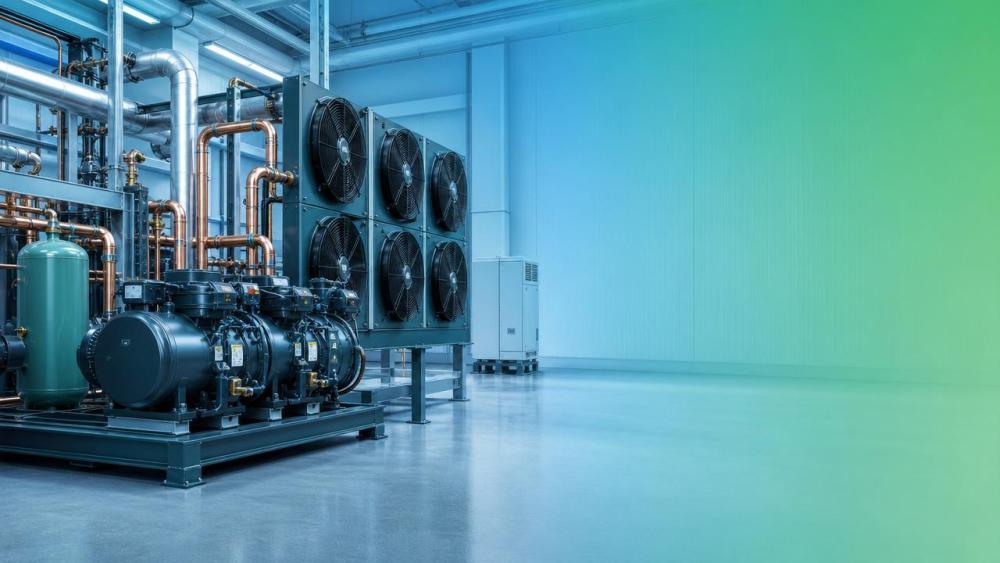
Most readers searching for low carbon refrigeration are not looking for theory alone. They want to know which technologies actually reduce emissions and whether those options save money over time.
For information researchers, the central question is usually practical: which refrigeration pathway offers the best combination of compliance security, operating efficiency, serviceability, and total cost control?
The short answer is that no single solution fits every application. However, systems using natural refrigerants, high-efficiency components, and intelligent controls often deliver the strongest long-term value.
That is especially true where operators face rising electricity prices, stricter refrigerant phase-down rules, or large cooling loads across cold storage, industrial chilling, food retail, and medical applications.
Instead of focusing only on purchase price, decision-makers should compare lifetime energy use, refrigerant leakage risk, maintenance complexity, equipment lifespan, and future regulatory exposure.
In many cases, a higher upfront investment in low carbon refrigeration is offset by lower power bills, reduced refrigerant replacement costs, and fewer retrofit disruptions later.
Why low carbon refrigeration is now a cost issue, not just a sustainability issue
Low carbon refrigeration used to be discussed mainly in environmental terms. Today, it is also a financial and strategic issue across the commercial cold-chain and industrial cooling landscape.
One reason is energy intensity. Refrigeration systems often operate continuously, making efficiency gains highly valuable over a ten- to twenty-year equipment life.
Another reason is refrigerant policy. Global F-gas restrictions, carbon reporting requirements, and refrigerant taxes are changing the economics of traditional high-GWP systems.
As a result, companies that delay system modernization may face increasing operating costs, rising compliance burdens, and shrinking access to approved refrigerants and replacement parts.
For global operators, this is even more important. A refrigeration choice that appears affordable today may become expensive if local regulations tighten or export-market standards shift.
This is why long-term cost analysis should include direct emissions from refrigerant leakage and indirect emissions from electricity use, not just equipment price or nameplate efficiency.
Which low carbon refrigeration technologies deserve the closest attention
When evaluating options, researchers should prioritize technologies that reduce both global warming impact and total ownership cost under real operating conditions.
The most important categories include natural refrigerant systems, advanced compressor platforms, heat recovery integration, variable-speed control, and digitally optimized operation.
Natural refrigerants usually lead the discussion because they offer very low or near-zero global warming potential compared with many conventional synthetic refrigerants.
The strongest candidates often include CO2, ammonia, and hydrocarbons, but their suitability depends heavily on system scale, safety requirements, ambient conditions, and application type.
CO2 refrigeration: strong compliance value and growing commercial relevance
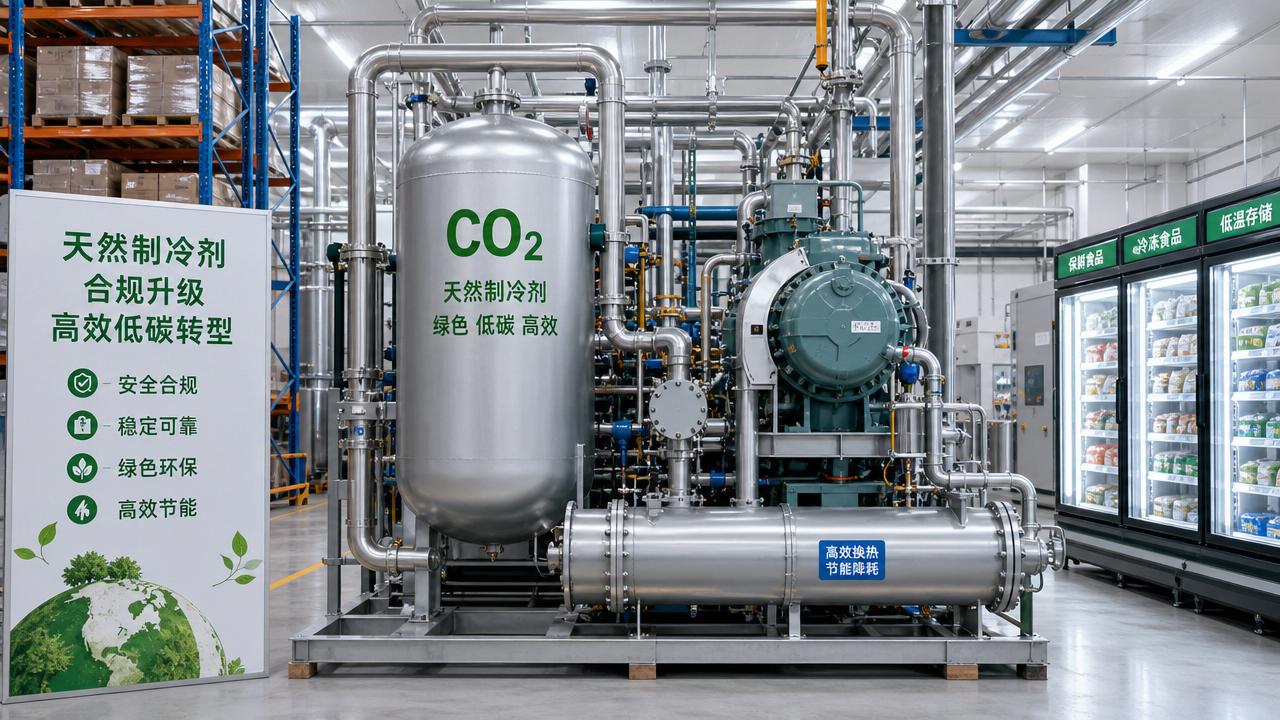
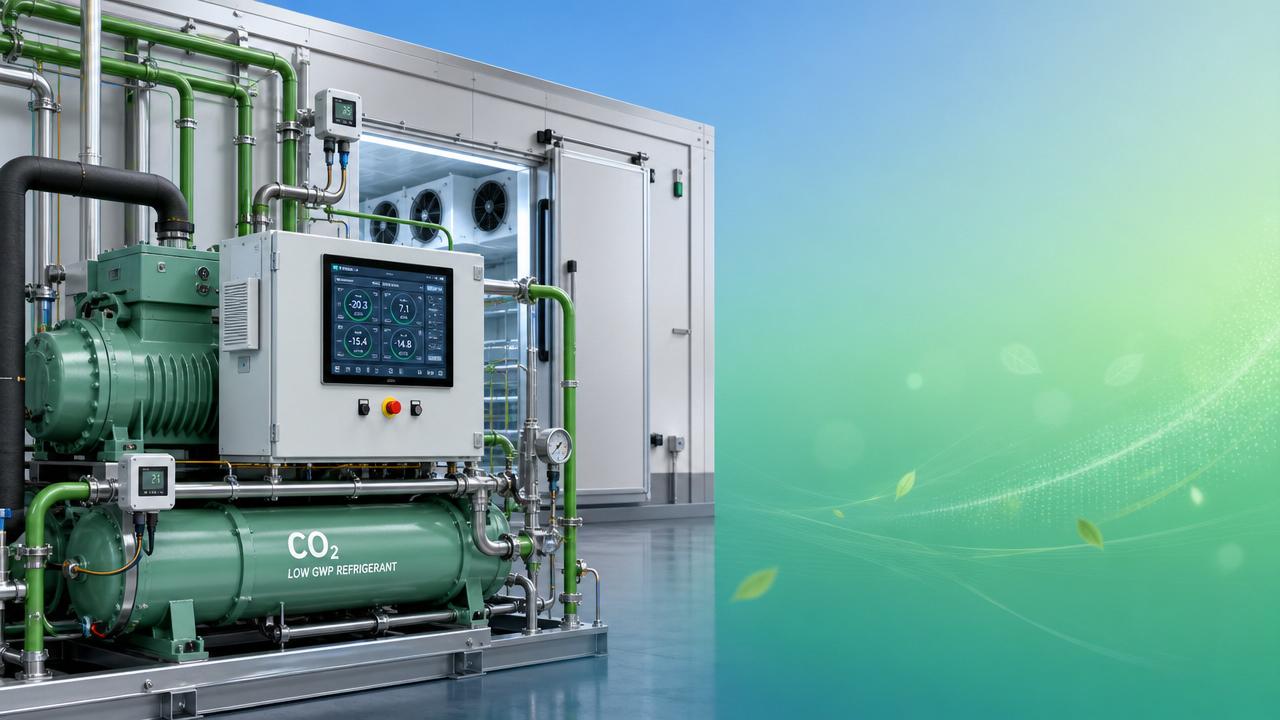
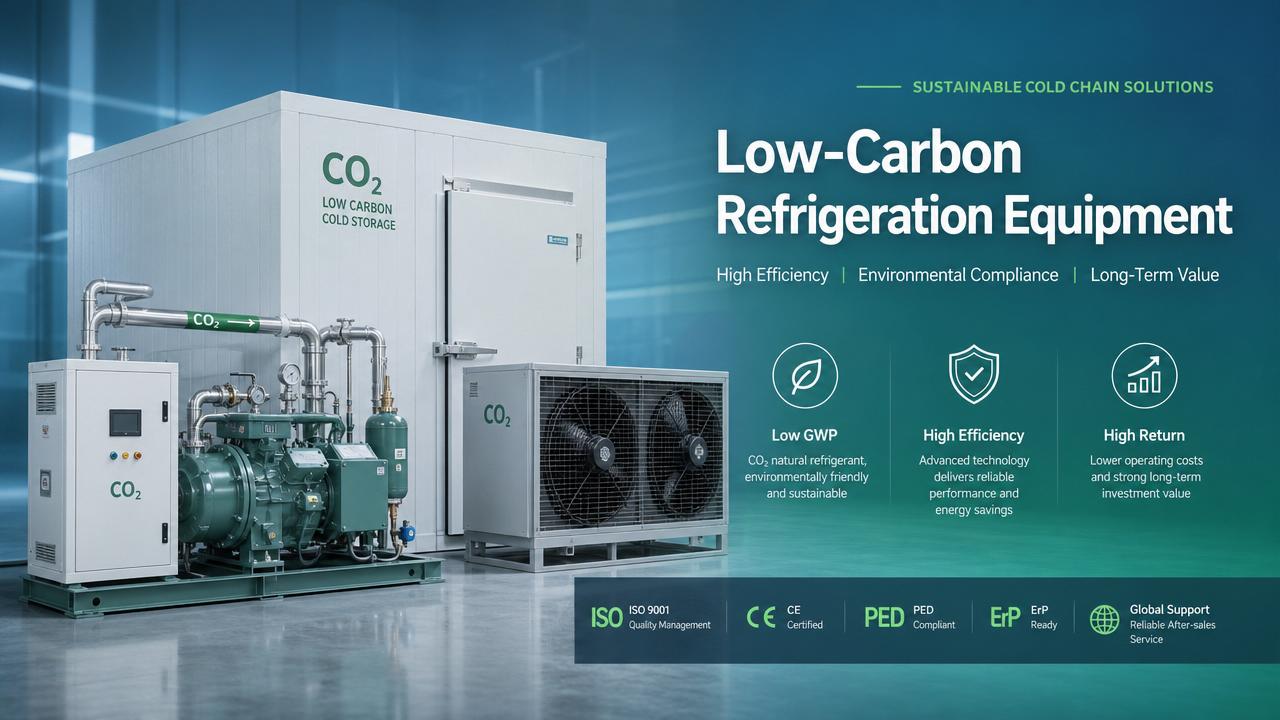
CO2 refrigeration has become one of the most visible low carbon refrigeration options, especially in commercial and cold storage applications affected by stricter refrigerant policies.
Its major advantage is extremely low global warming potential, which reduces long-term regulatory risk and makes it attractive for businesses planning future-proof infrastructure.
CO2 systems have also improved significantly in performance. Modern ejectors, parallel compression, and gas cooler optimization have expanded their viability in warmer climates.
For supermarkets, distribution hubs, and some food processing environments, CO2 can offer a compelling balance of environmental performance and reliable temperature control.
That said, researchers should not assume all CO2 systems perform equally. Transcritical operation, ambient profile, control quality, and technician capability all influence lifecycle economics.
In poorly designed projects, energy penalties or service complications can erode expected savings. In well-engineered projects, CO2 can deliver strong long-term resilience and cost predictability.
Ammonia systems: highly efficient for industrial users, but best where technical capacity is strong
Ammonia remains a leading option for large-scale industrial refrigeration because it combines excellent thermodynamic performance with zero global warming potential.
In facilities such as food manufacturing plants, cold storage warehouses, and process-cooling operations, ammonia often delivers very strong efficiency over long duty cycles.
Lower energy use can translate into major savings where refrigeration loads are large and constant. This makes ammonia especially relevant for operators focused on deep lifecycle optimization.
However, ammonia is not a universal answer. Toxicity considerations, safety design requirements, operator training, and regulatory handling obligations can increase project complexity.
For that reason, ammonia is usually most attractive where experienced engineering teams, robust safety management, and sufficient site scale justify the additional system discipline.
Some operators reduce risk through low-charge ammonia designs, which preserve many efficiency benefits while improving site acceptance and reducing refrigerant inventory.
Hydrocarbon systems: efficient and low-GWP, but best for smaller or modular applications
Hydrocarbons such as propane can be excellent low carbon refrigeration options where compact charge size, high efficiency, and simple architecture are priorities.
They are increasingly common in display cabinets, plug-in units, small condensing systems, and specialized commercial refrigeration equipment where energy performance matters greatly.
Because hydrocarbons have very low global warming potential and good thermodynamic characteristics, they can support both emissions reduction and electricity savings.
Still, flammability rules define their practical limits. Charge restrictions, ventilation requirements, and applicable safety standards must be reviewed early in equipment selection.
For researchers, the key point is that hydrocarbons often work best in distributed or self-contained applications rather than large centralized systems with complex site conditions.
Efficiency upgrades that often cut costs faster than refrigerant change alone
While refrigerant selection is important, many long-term savings come from system efficiency improvements that reduce energy demand regardless of refrigerant chemistry.
Variable-speed compressors and fans are among the most effective upgrades. They allow refrigeration systems to match output to real load instead of cycling inefficiently.
High-efficiency screw compressors, magnetic bearing chillers, and improved evaporator and condenser designs can also deliver measurable reductions in electricity use.
In cold storage and process cooling, advanced defrost control, floating suction pressure, and floating head pressure strategies often produce meaningful savings with manageable payback periods.
Door management, air curtain optimization, insulation quality, and heat exchanger cleanliness should not be overlooked either. Small thermal losses become expensive in around-the-clock operations.
Researchers comparing low carbon refrigeration pathways should therefore separate “refrigerant impact” from “system efficiency impact,” then evaluate the combined opportunity.
Digital controls and monitoring often make the economics work
Many low carbon refrigeration investments underperform not because the equipment is weak, but because controls are poorly configured or system data is not actively used.
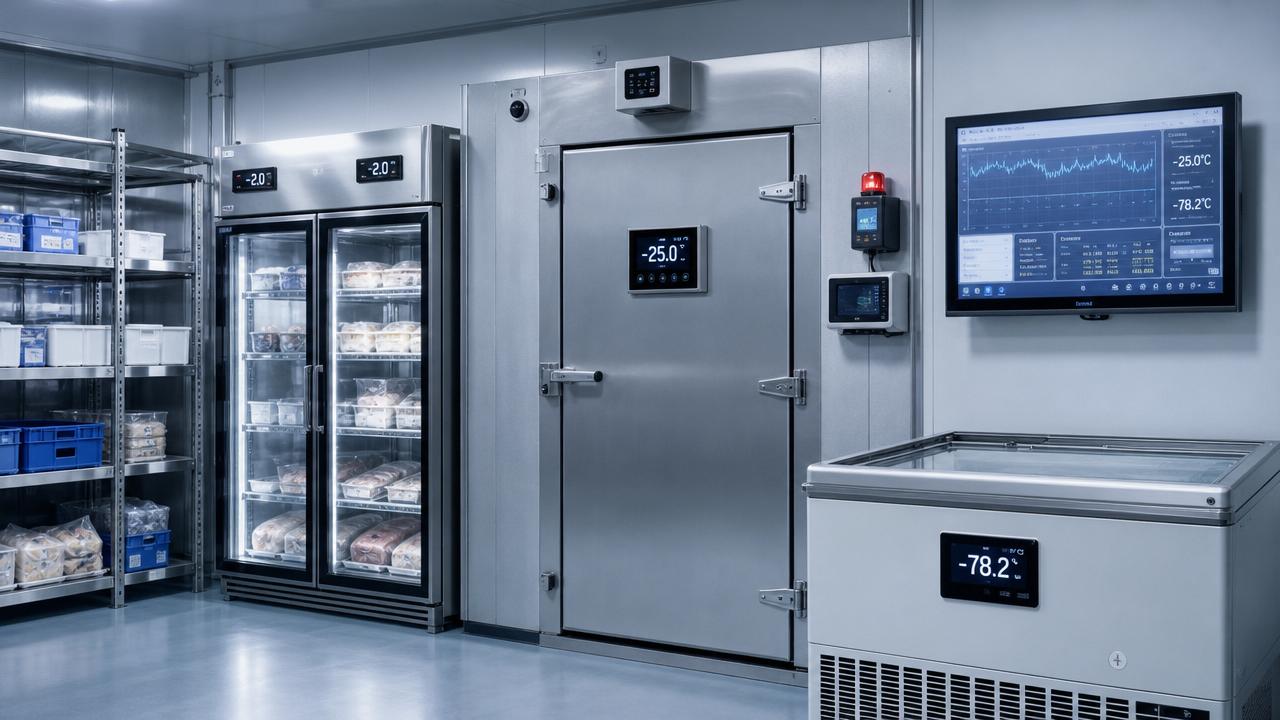
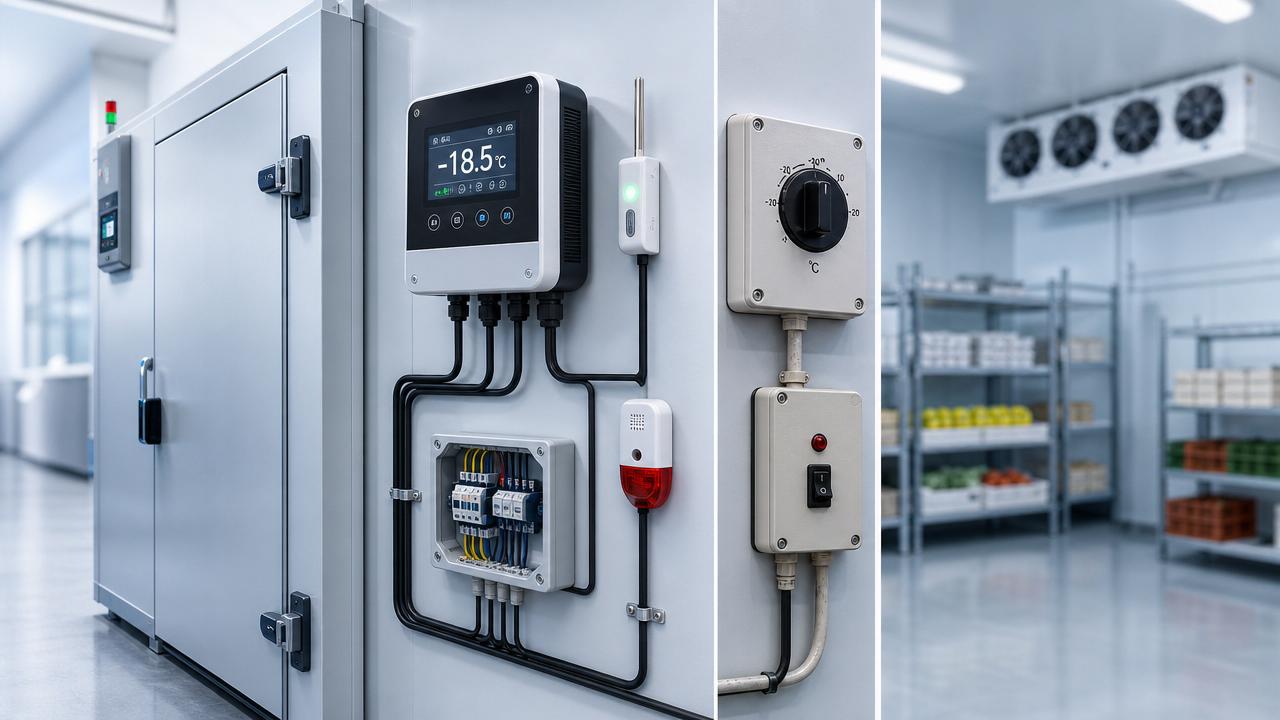
Digital monitoring helps operators detect refrigerant leakage, compressor inefficiency, frosting issues, unstable superheat, and unnecessary low-temperature setpoints before they drive costs upward.
AI-assisted control strategies are also becoming more relevant in larger cold-chain networks. They can optimize defrost timing, load balancing, and compressor staging across varying demand patterns.
For researchers, this matters because low carbon refrigeration should be evaluated as an operating ecosystem, not just as a hardware purchase.
In many facilities, a moderate retrofit combining controls, sensors, and high-efficiency components can outperform a more expensive refrigerant-only replacement strategy.
How to judge long-term cost savings without oversimplifying the business case
To understand whether low carbon refrigeration will really cut long-term costs, researchers need a lifecycle framework rather than a simple upfront-versus-energy comparison.
Start with five cost layers: capital expenditure, annual energy use, refrigerant management, maintenance burden, and regulatory risk over the expected equipment lifespan.
Energy is usually the biggest cost driver, especially in industrial chillers, cold storage compressors, and commercial refrigeration cabinets with extended operating hours.
Next, estimate leakage exposure and refrigerant replacement cost. A system using expensive or increasingly restricted refrigerants may look acceptable today but become costly later.
Maintenance should include technician availability, spare parts accessibility, downtime sensitivity, and control-system complexity. A highly efficient system is less attractive if service support is limited.
Regulatory risk should include possible bans, quota pressure, reporting obligations, or carbon-cost mechanisms in the markets where the equipment will operate or be exported.
Finally, consider useful life and residual adaptability. Systems designed around low-GWP refrigerants and modern controls are often better positioned for future upgrades.
Best-fit scenarios by application type
Different applications require different low carbon refrigeration choices, and this is where many technology comparisons become more useful than generic product claims.
In industrial process cooling, energy efficiency and uptime often dominate. High-efficiency chillers, ammonia systems, and advanced compressor technologies usually deserve priority review.
In cold storage hubs, researchers should focus on compressor reliability, part-load performance, refrigerant compliance security, and the economics of large continuous loads.
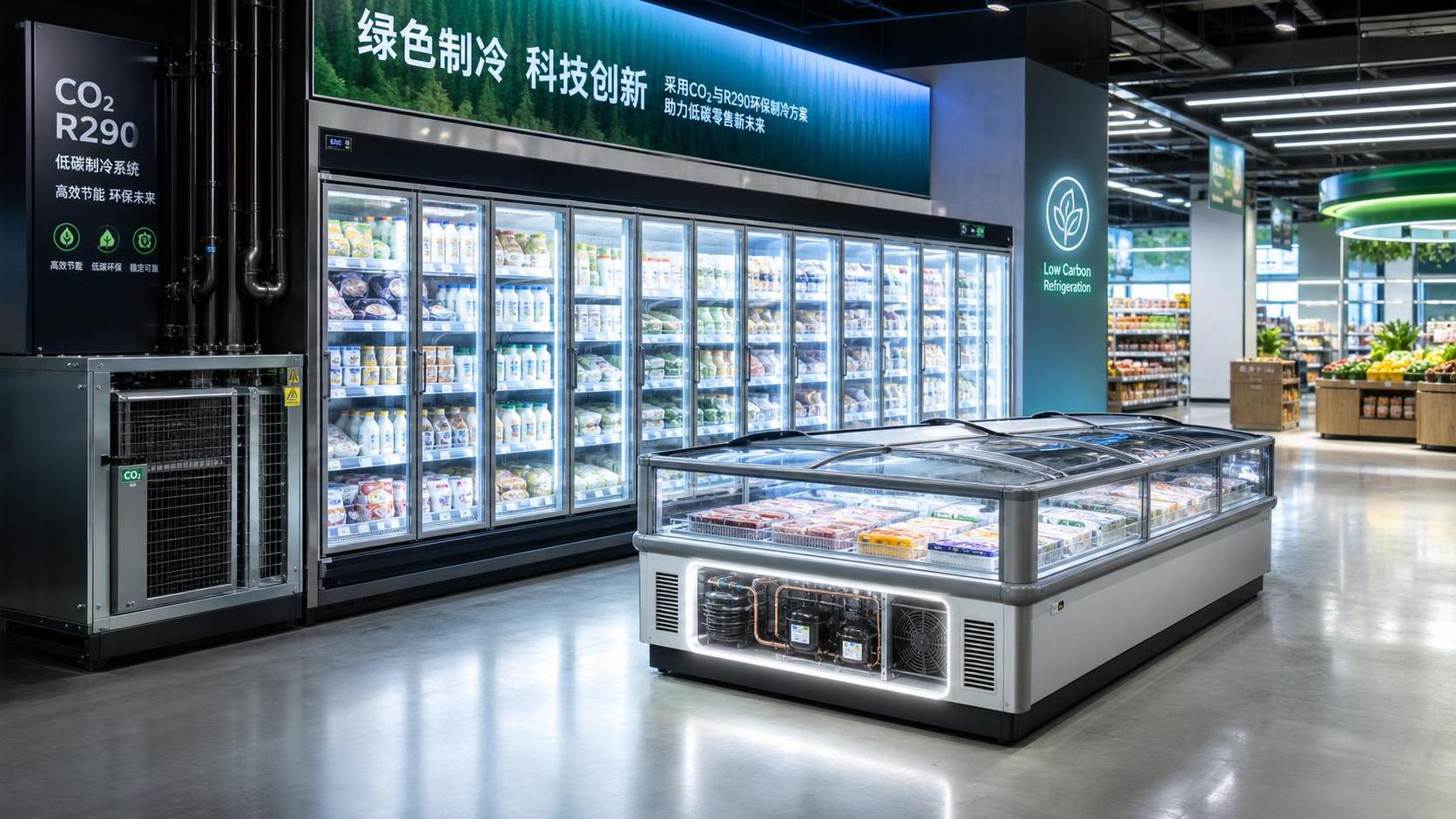
For food retail and commercial display environments, CO2 systems, hydrocarbon cabinets, anti-fog performance, lighting efficiency, and air curtain design can materially influence total cost.
In medical and ultra-low temperature applications, system architecture, temperature stability, backup protection, and lifecycle reliability can outweigh simple energy comparisons.
The right question is not “Which refrigerant is best?” but “Which low carbon refrigeration design best matches this operational profile and risk environment?”
Common mistakes that distort low carbon refrigeration decisions
One common mistake is assuming a low-GWP refrigerant automatically produces low operating cost. Poor control logic or weak component matching can cancel out environmental advantages.
Another mistake is relying on nominal efficiency ratings without reviewing climate conditions, load profile, defrost behavior, or seasonal operating variations.
Some buyers also underestimate training and service requirements. A technically advanced solution may not deliver expected value if local maintenance capacity is insufficient.
Others focus too narrowly on immediate payback and ignore refrigerant phase-down risk, future retrofit costs, or disruptions tied to non-compliant equipment.
For information researchers, the lesson is clear: compare systems as real assets in real environments, not as isolated specification sheets.
A practical evaluation checklist for researchers and decision support teams
When screening low carbon refrigeration options, begin by mapping the application’s temperature range, annual load pattern, ambient conditions, and operational criticality.
Then review refrigerant pathway, energy performance, expected leakage rate, safety requirements, control strategy, and technician support availability in the target market.
Ask suppliers for lifecycle energy models, not just headline efficiency claims. Request assumptions on ambient temperature, part-load behavior, and maintenance intervals.
Also examine whether the system supports heat recovery, remote monitoring, predictive maintenance, and future component upgrades, since these features improve long-term economics.
Where possible, compare at least three scenarios: baseline replacement, efficiency-focused retrofit, and full low carbon refrigeration redesign using future-compliant refrigerants.
This structured approach helps researchers move from broad market information to a more defensible investment perspective.
Conclusion: the lowest-carbon option is not always the cheapest upfront, but often the smartest over time
Low carbon refrigeration is no longer a niche sustainability topic. It is a core decision area linking energy cost, compliance risk, equipment longevity, and operational reliability.
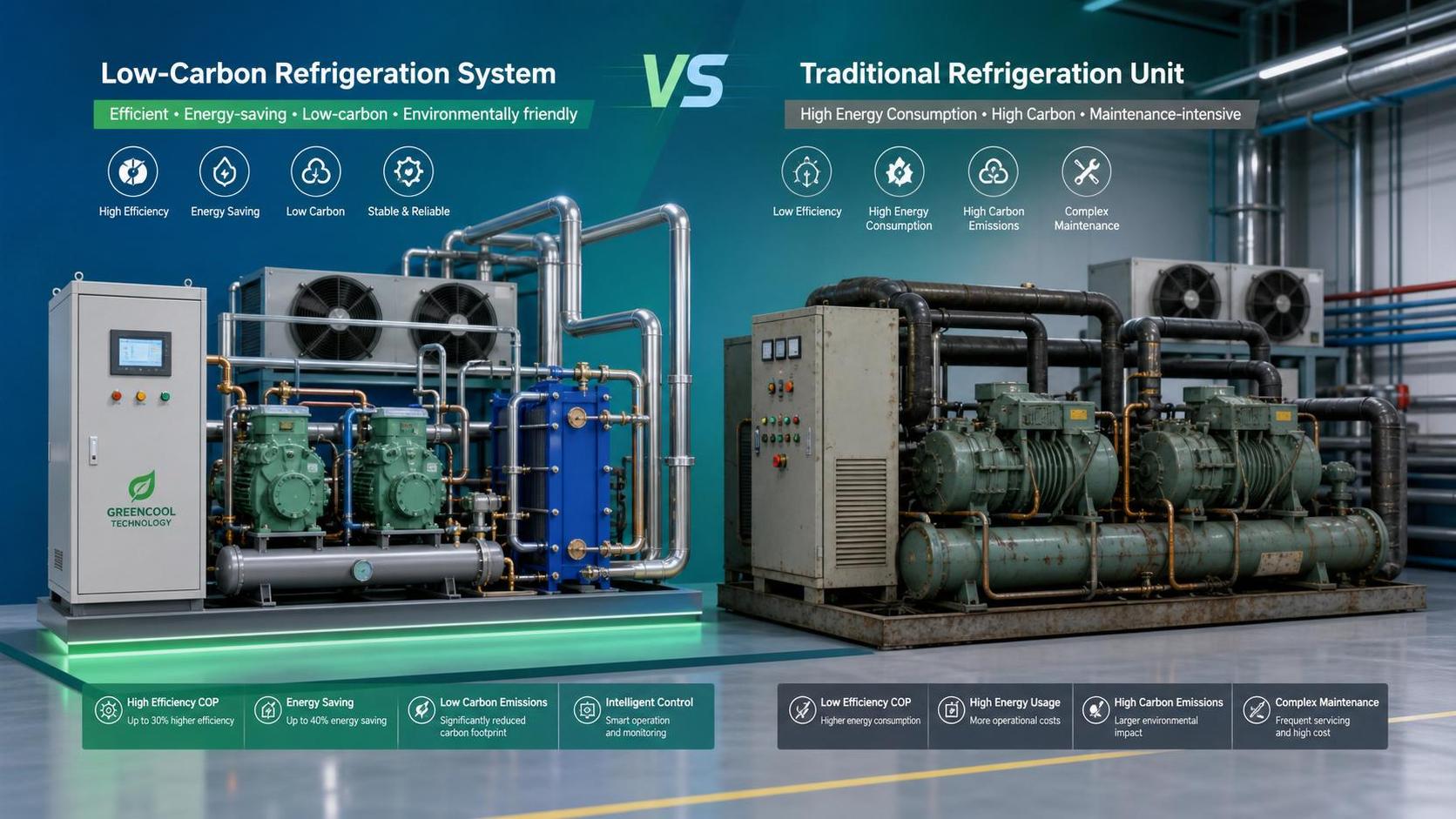
For most commercial and industrial users, the strongest long-term results come from combining low-GWP refrigerants with efficient compressors, smart controls, and application-specific system design.
CO2, ammonia, and hydrocarbons each have clear strengths, but their value depends on site conditions, safety context, service capability, and load profile.
The most useful takeaway for researchers is that long-term cost reduction rarely comes from refrigerant choice alone. It comes from a well-matched low carbon refrigeration strategy.
Organizations that evaluate these systems through lifecycle economics rather than first cost are more likely to reduce emissions, control energy spending, and avoid future compliance disruption.
Recommended News
 Eco-Refrigerant & ComplianceF-Gas Regulations Are Changing Equipment Choices Faster Than ExpectedAnalyst :Dr. Henrik Weber
 Eco-Refrigerant & ComplianceEco-Friendly Refrigeration: What Looks Green but Performs Poorly?Analyst :Dr. Henrik Weber
 Eco-Refrigerant & ComplianceNatural Refrigerants: Are Compliance Benefits Worth the Transition Cost?Analyst :Dr. Henrik Weber
 Eco-Refrigerant & ComplianceWhat drives low carbon refrigeration adoption in 2026?Analyst :Dr. Henrik Weber
 Eco-Refrigerant & ComplianceEco-friendly cooling is changing compliance planning fastAnalyst :Dr. Henrik Weber
 Eco-Refrigerant & ComplianceLow carbon cooling trends that could reshape investmentsAnalyst :Dr. Henrik Weber
 Eco-Refrigerant & ComplianceHow F-Gas regulations are changing refrigerant decisionsAnalyst :Dr. Henrik Weber
 Eco-Refrigerant & ComplianceIs eco-friendly refrigeration worth the higher upfront costAnalyst :Dr. Henrik Weber
 Eco-Refrigerant & ComplianceWhy low carbon cooling is becoming a compliance priorityAnalyst :Dr. Henrik Weber
 Eco-Refrigerant & ComplianceLow carbon refrigeration options that cut long-term costsAnalyst :Dr. Henrik Weber
 Eco-Refrigerant & ComplianceWhat buyers miss when choosing eco-friendly refrigerationAnalyst :Dr. Henrik Weber
 Eco-Refrigerant & ComplianceWhy low carbon refrigeration is becoming a board issueAnalyst :Dr. Henrik Weber
 Eco-Refrigerant & ComplianceWhat F-Gas regulations mean for equipment choices in 2026Analyst :Dr. Henrik Weber
![]() Eco-Refrigerant & ComplianceIndonesia Launches Green Refrigeration Channel for R290 Cold CabinetsAnalyst :Dr. Henrik Weber
Eco-Refrigerant & ComplianceIndonesia Launches Green Refrigeration Channel for R290 Cold CabinetsAnalyst :Dr. Henrik Weber Eco-Refrigerant & ComplianceWhy low carbon cooling is becoming a safer long betAnalyst :Dr. Henrik Weber
 Eco-Refrigerant & ComplianceWhat makes eco-friendly cooling cheaper over time?Analyst :Dr. Henrik Weber
 Eco-Refrigerant & ComplianceF-Gas regulations are changing how cooling gets approvedAnalyst :Dr. Henrik Weber
 Eco-Refrigerant & ComplianceHow eco-friendly refrigeration cuts compliance riskAnalyst :Dr. Henrik Weber
 Eco-Refrigerant & ComplianceHow low carbon cooling cuts compliance risk in 2026Analyst :Dr. Henrik Weber
 Eco-Refrigerant & ComplianceLow Carbon Refrigeration: Compare Refrigerants, Energy Use, and ComplianceAnalyst :Dr. Henrik Weber
 Eco-Refrigerant & ComplianceEco-Friendly Cooling Options: Refrigerants, Efficiency, and Compliance ChecksAnalyst :Dr. Henrik Weber
![]() Eco-Refrigerant & ComplianceWhat Are Natural Refrigerants? Types, GWP Limits, and Where They Fit BestAnalyst :Dr. Henrik Weber
Eco-Refrigerant & ComplianceWhat Are Natural Refrigerants? Types, GWP Limits, and Where They Fit BestAnalyst :Dr. Henrik Weber Eco-Refrigerant & ComplianceEco-Friendly Cooling vs Conventional Systems: What Buyers Should Compare FirstAnalyst :Dr. Henrik Weber
 Eco-Refrigerant & ComplianceEco-Friendly Refrigeration vs Conventional Systems: Refrigerants, Energy Use, and ComplianceAnalyst :Dr. Henrik Weber
 Eco-Refrigerant & ComplianceLow Carbon Refrigeration: Key Standards, Refrigerant Options, and ROI FactorsAnalyst :Dr. Henrik Weber
 Eco-Refrigerant & ComplianceTemperature Control Standards for Food Storage: Critical Limits, Logging, and Audit ChecksAnalyst :Dr. Henrik Weber
 Eco-Refrigerant & ComplianceLow Carbon Cooling Options Explained: Refrigerants, Compliance, and System Trade-OffsAnalyst :Dr. Henrik Weber
 Eco-Refrigerant & ComplianceDigital Refrigeration vs Conventional Controls: What Improves Monitoring and Compliance?Analyst :Dr. Henrik Weber
 Eco-Refrigerant & ComplianceLow Carbon Cooling Options for Commercial Refrigeration: CO2, Ammonia, and Hybrid SystemsAnalyst :Dr. Henrik Weber
 Eco-Refrigerant & ComplianceLow Carbon Cooling Options Compared: CO2, Ammonia, and HFO Systems for ComplianceAnalyst :Dr. Henrik Weber
 Eco-Refrigerant & ComplianceIndustrial Refrigeration Systems Buying Guide: Lifecycle Cost, Efficiency, and ComplianceAnalyst :Dr. Henrik Weber
 Eco-Refrigerant & ComplianceEco-Friendly Cooling Options: Refrigerants, Energy Use, and Compliance Factors ComparedAnalyst :Dr. Henrik Weber
 Eco-Refrigerant & ComplianceNatural Refrigerants vs HFCs: How to Compare Compliance, Safety, and System DesignAnalyst :Dr. Henrik Weber
 Eco-Refrigerant & ComplianceHow to Read Specification-Oriented Product Guides for Refrigeration EquipmentAnalyst :Dr. Henrik Weber
 Eco-Refrigerant & ComplianceLow Carbon Refrigeration Options for Supermarkets: CAPEX, Energy Use, and Compliance ComparedAnalyst :Dr. Henrik Weber
 Eco-Refrigerant & ComplianceRACC 2026 to Host PFAS Compliance Briefing in HangzhouAnalyst :Dr. Henrik Weber
 Eco-Refrigerant & ComplianceEPA Rule Challenge Raises HFC Supply Chain ConcernsAnalyst :Dr. Henrik Weber
 Eco-Refrigerant & ComplianceLow Carbon Refrigeration Systems vs Conventional Setups: Which Delivers Lower Lifecycle Cost?Analyst :Dr. Henrik Weber
 Eco-Refrigerant & ComplianceLow GWP Refrigeration Explained: Refrigerants, Regulations, and System Trade-OffsAnalyst :Dr. Henrik Weber
 Eco-Refrigerant & ComplianceLow Carbon Refrigeration Systems Retrofit: When to Upgrade and Which Changes Matter MostAnalyst :Dr. Henrik Weber