Industry News
Curation by industry experts
Hot Articles
- Cold Chain & Retail Energy InsightsHow to Compare Energy Ratings in Specification-Led Refrigeration Equipment Guides
- Cold Chain & Retail Energy InsightsCold Chain Technology: How Sensors and Automation Prevent Temperature Excursions
- Cold Chain & Retail Energy InsightsHow North American Cold Facilities Can Benchmark Refrigeration System Efficiency
Popular Tags
Why low carbon cooling is becoming a compliance priority
For business leaders across refrigeration, cold chain, and industrial cooling, low carbon cooling is no longer just a sustainability ambition—it is rapidly becoming a compliance imperative. As F-Gas rules tighten, energy standards rise, and customers demand greener operations, choosing the right refrigerants and system designs now directly affects market access, operating costs, and brand credibility.
For decision-makers managing cold storage hubs, industrial chillers, commercial refrigeration cabinets, ice-making systems, or ultra-low temperature freezers, the issue is no longer whether change is coming. The issue is how quickly existing assets, procurement standards, and export strategies can adapt to new environmental rules without disrupting uptime, product integrity, or project economics.
Across the global refrigeration value chain, low carbon cooling now sits at the intersection of three board-level concerns: regulatory exposure, energy cost control, and customer qualification. A system that uses the wrong refrigerant, misses a seasonal efficiency threshold, or fails documentation checks can delay a project by 3–6 months, increase retrofit costs, or restrict access to regulated markets.
That is why operators, equipment manufacturers, and investors are paying closer attention to refrigerant transition planning, lifecycle efficiency, and compliance-ready engineering. In sectors such as fresh retail, food processing, pharmaceuticals, and high-end manufacturing, low carbon cooling has become a practical business requirement rather than a marketing message.
Why compliance pressure is accelerating across cooling applications
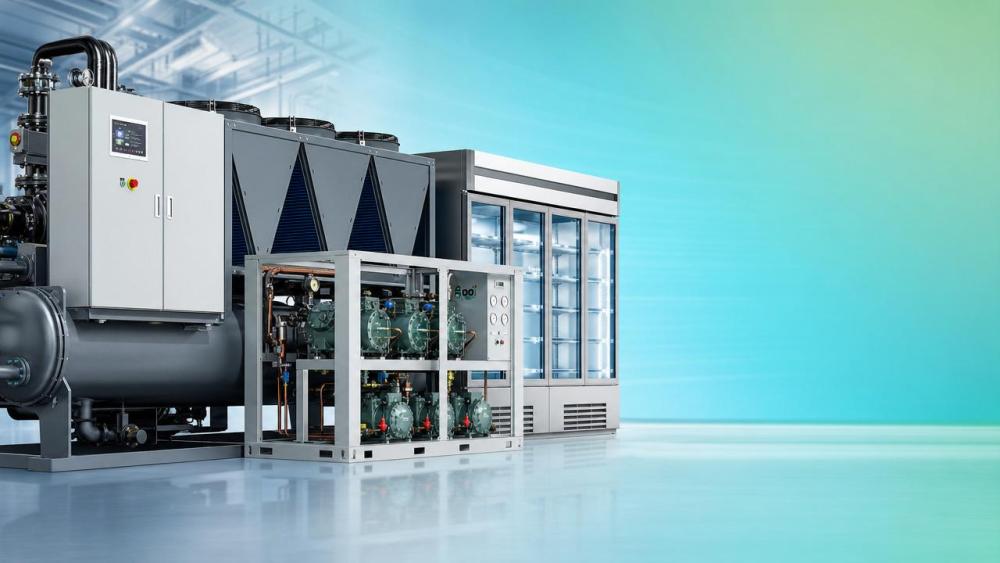
Compliance pressure is rising because cooling systems are exposed to more than one rule set at the same time. Refrigerant restrictions, energy performance requirements, leak management duties, and customer procurement standards are increasingly linked. In many projects, failing one requirement can block the whole delivery, even if thermal performance is otherwise acceptable.
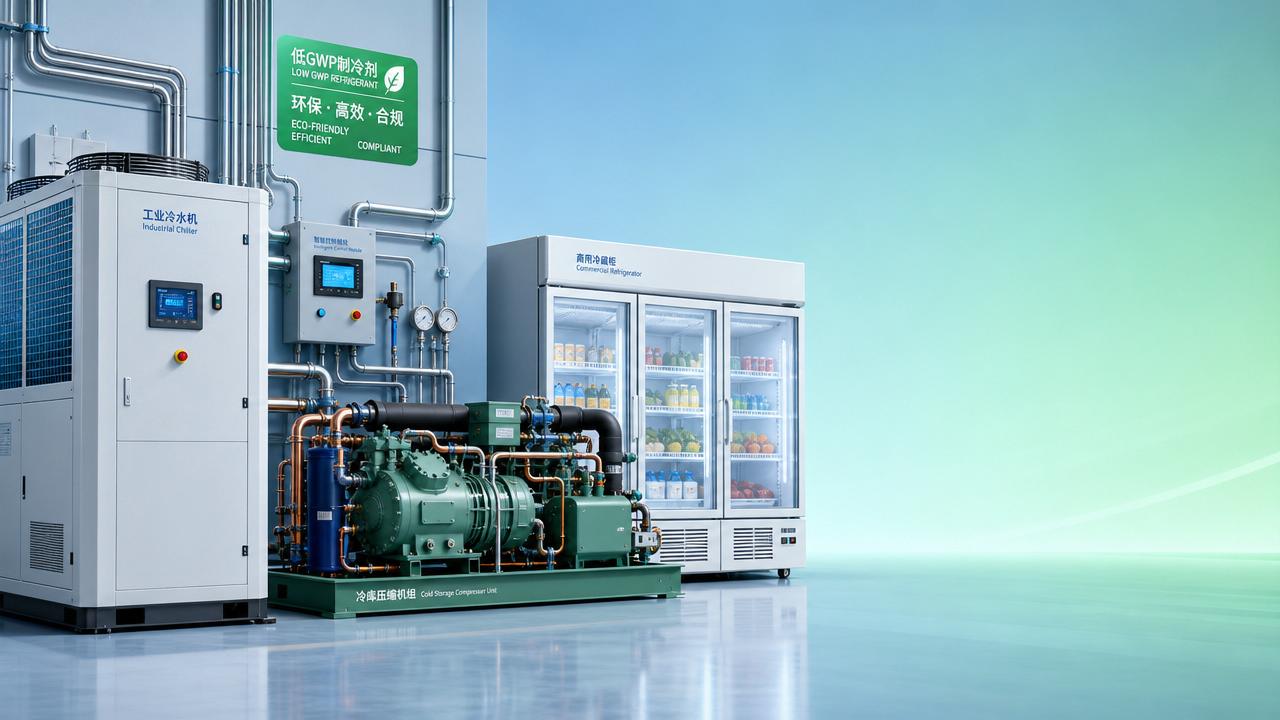
For example, an industrial chiller exported into a stricter market may need a lower-GWP refrigerant, updated labeling, revised servicing procedures, and documented performance under local ambient conditions. A cold room compressor package may also need proof of leak safety design, technician readiness, and parts availability over a 5–10 year operating horizon.
The compliance shift is broader than refrigerant phase-down
Many executives still associate low carbon cooling only with refrigerant replacement. In reality, compliance now covers at least 4 dimensions: direct emissions, indirect emissions from electricity use, safety classification, and service traceability. This is especially important in distributed retail cabinets, large cold storage plants, and deep-cryogenic medical equipment, where operating conditions vary sharply.
A refrigeration cabinet with a low-GWP refrigerant but poor door sealing, unstable air curtain control, or inefficient defrost logic may still underperform in energy audits. Likewise, an ultra-low temperature freezer can reduce environmental impact only if pull-down time, insulation quality, and cascade system stability are properly engineered. Compliance is increasingly judged as a system outcome, not a single component choice.
Why this matters for cold chain, industrial cooling, and medical storage
- Fresh food logistics depend on stable temperature bands such as 0°C–4°C, -18°C, or below -30°C, where interruptions can quickly create spoilage and claims.
- Industrial chillers often run 12–24 hours per day, making seasonal efficiency and compressor control strategy major compliance and cost factors.
- Medical deep-cryogenic equipment operating at -86°C or lower faces stricter risk tolerance for alarms, backup power integration, and temperature recovery time.
- Large-scale ice systems supporting fisheries, concrete cooling, or processing plants must balance cooling capacity, water consumption, and energy intensity.
For these segments, low carbon cooling affects both operational resilience and commercial acceptance. Buyers are increasingly screening suppliers before RFQ release, not after shipment. That means compliance capability now influences bid eligibility, not only post-sale service risk.
Typical business risks when adaptation is delayed
Delayed adaptation can create 3 common outcomes. First, projects face redesign after tender award, which often adds 2–8 weeks to engineering schedules. Second, service teams may struggle with new refrigerants if technician training and spare parts planning were not budgeted early. Third, end users may face rising total cost of ownership if they prioritize low upfront price over energy and compliance fit.
The table below outlines how compliance priorities differ across major cooling segments covered by CCRS, from industrial process cooling to life science preservation.
The key takeaway is that low carbon cooling does not mean one universal solution. Compliance priorities depend on operating temperature, refrigerant type, site risk, and service capability. Businesses that segment applications early usually make better capex decisions and avoid expensive redesign later.
What low carbon cooling means in practical procurement terms
For enterprise buyers, low carbon cooling should be translated into measurable procurement criteria. A practical evaluation model often includes 5 checkpoints: refrigerant pathway, annual energy performance, equipment safety fit, serviceability, and documentation readiness. Without these five, supplier comparison tends to become subjective and price-driven.
This matters because two systems with similar cooling capacity can have very different lifecycle impacts. A 100 kW chiller optimized for part-load operation may produce lower annual electricity use than a nominally cheaper unit that cycles inefficiently. A cold storage system built for natural refrigerants may also require higher upfront engineering effort but lower long-term regulatory exposure.
Five procurement questions every decision-maker should ask
- What is the refrigerant’s long-term regulatory outlook in our target market over the next 3–7 years?
- How does the system perform at full load and part load under real ambient conditions?
- What safety design changes are required for flammable or high-pressure refrigerants?
- Can local service teams support commissioning, leak checks, and component replacement within 24–72 hours?
- What documents are available for audit, customs, customer qualification, and internal ESG review?
These questions help move the discussion from broad sustainability claims to implementation reality. They are especially useful when comparing CO2 transcritical options, hydrocarbon-based units, lower-GWP blends, and cascade systems used in pharmaceutical or laboratory settings.
How lifecycle economics change the buying decision
In many facilities, cooling equipment operates for 8,000 hours per year or more. That means electricity, maintenance, refrigerant management, and downtime risk often outweigh the original purchase price within 24–36 months. Low carbon cooling becomes commercially attractive when buyers evaluate total cost of ownership rather than capex in isolation.
This is particularly visible in supermarket cabinets, food distribution centers, and industrial process plants. Better evaporator control, inverter-driven compression, optimized heat exchangers, and digital monitoring can reduce avoidable energy use. Even modest gains of 8%–15% in yearly consumption may significantly improve project economics in multi-unit installations.
Common buying mistakes
- Selecting a refrigerant only for current legality, without considering future restriction risk.
- Using nominal capacity as the main comparison point, while ignoring ambient extremes or partial-load behavior.
- Underestimating the service implications of natural refrigerants or cascade architectures.
- Failing to review controls, defrost strategy, and insulation quality in display and storage equipment.
To make procurement more actionable, the following table shows a practical comparison framework for evaluating low carbon cooling options in B2B projects.
The most resilient procurement decisions are the ones that align these five factors with the intended use case. A pharmaceutical freezer, a fish processing ice system, and a retail multi-deck cabinet may all pursue low carbon cooling, but their compliance logic and risk profile are not the same.
How to implement a low carbon cooling roadmap without disrupting operations
Implementation should begin with an asset and risk map, not with a rush to replace all equipment. Most enterprises can phase the transition in 3 stages: audit current systems, prioritize high-risk or high-consumption assets, and then align new procurement with a 2–5 year technology roadmap. This approach helps preserve uptime while improving compliance visibility.
In practice, a cold chain operator may first identify older high-GWP systems with frequent leaks, then review site-by-site energy intensity, and finally group upgrades by facility type. A manufacturer serving export markets may instead start with new product platform redesign, documentation updates, and service partner training to reduce certification friction.
A practical 3-stage implementation model
Stage 1: Baseline audit
Review refrigerants in use, system age, leak history, energy profile, and maintenance burden. For a medium-sized portfolio, this can often be completed in 2–6 weeks. The objective is to identify which assets create the highest compliance or cost exposure first.
Stage 2: Prioritization and technology matching
Match applications to appropriate technical pathways. CO2 may fit centralized cold storage or supermarket systems. Hydrocarbon solutions may suit certain self-contained cabinets. Improved screw or magnetic bearing chillers may offer strong gains in industrial process cooling. Cascade architectures remain relevant for ultra-low temperature preservation where stable deep cryogenic performance is essential.
Stage 3: Execution and verification
Execution should include engineering review, commissioning plan, safety checks, operator training, and post-installation verification. A sensible verification window is often 30–90 days, long enough to review alarms, part-load behavior, temperature stability, and energy consumption under normal operating loads.
Where intelligence support adds value
This is where industry intelligence matters. Businesses do not just need equipment data; they need translated insight on refrigerant policy, thermodynamic performance, and lifecycle economics. Platforms such as CCRS are valuable because they connect regulatory tracking, heat transfer analysis, and retrofit economics across industrial chillers, ice systems, compressors, cabinets, and ultra-low temperature solutions.
For executive teams, that integrated view supports faster and more defensible decisions. It helps answer questions such as whether a transcritical CO2 configuration suits a particular climate, how AI defrosting may improve cabinet efficiency, or when a freezer upgrade delivers more value than continued maintenance on aging equipment.
Questions leaders should keep asking over the next 12 months
- Which sites face the highest exposure to refrigerant restrictions or servicing complexity?
- Which 20% of cooling assets consume a disproportionate share of electricity?
- Are new bids and product lines aligned with future customer sustainability requirements?
- Do engineering, procurement, and maintenance teams use the same compliance criteria?
- Can suppliers provide clear technical files, performance evidence, and transition guidance?
Low carbon cooling is becoming a compliance priority because regulation, cost, and commercial qualification are now moving together. Enterprises that treat cooling strategy as a cross-functional issue—spanning engineering, procurement, operations, and market access—are far better positioned to reduce risk and capture value.
For organizations involved in refrigeration, cold chain, industrial cooling, or deep-cryogenic storage, the next step is not simply to buy newer equipment. It is to build a roadmap that links refrigerant transition, energy performance, safety design, and service readiness into one decision framework. To explore tailored low carbon cooling strategies, compare solution pathways, or review compliance-sensitive applications, contact CCRS to get a customized plan and deeper technical guidance.
Recommended News
 Eco-Refrigerant & ComplianceF-Gas Regulations Are Changing Equipment Choices Faster Than ExpectedAnalyst :Dr. Henrik Weber
 Eco-Refrigerant & ComplianceEco-Friendly Refrigeration: What Looks Green but Performs Poorly?Analyst :Dr. Henrik Weber
 Eco-Refrigerant & ComplianceNatural Refrigerants: Are Compliance Benefits Worth the Transition Cost?Analyst :Dr. Henrik Weber
 Eco-Refrigerant & ComplianceWhat drives low carbon refrigeration adoption in 2026?Analyst :Dr. Henrik Weber
 Eco-Refrigerant & ComplianceEco-friendly cooling is changing compliance planning fastAnalyst :Dr. Henrik Weber
 Eco-Refrigerant & ComplianceLow carbon cooling trends that could reshape investmentsAnalyst :Dr. Henrik Weber
 Eco-Refrigerant & ComplianceHow F-Gas regulations are changing refrigerant decisionsAnalyst :Dr. Henrik Weber
 Eco-Refrigerant & ComplianceIs eco-friendly refrigeration worth the higher upfront costAnalyst :Dr. Henrik Weber
 Eco-Refrigerant & ComplianceWhy low carbon cooling is becoming a compliance priorityAnalyst :Dr. Henrik Weber
 Eco-Refrigerant & ComplianceLow carbon refrigeration options that cut long-term costsAnalyst :Dr. Henrik Weber
 Eco-Refrigerant & ComplianceWhat buyers miss when choosing eco-friendly refrigerationAnalyst :Dr. Henrik Weber
 Eco-Refrigerant & ComplianceWhy low carbon refrigeration is becoming a board issueAnalyst :Dr. Henrik Weber
 Eco-Refrigerant & ComplianceWhat F-Gas regulations mean for equipment choices in 2026Analyst :Dr. Henrik Weber
![]() Eco-Refrigerant & ComplianceIndonesia Launches Green Refrigeration Channel for R290 Cold CabinetsAnalyst :Dr. Henrik Weber
Eco-Refrigerant & ComplianceIndonesia Launches Green Refrigeration Channel for R290 Cold CabinetsAnalyst :Dr. Henrik Weber Eco-Refrigerant & ComplianceWhy low carbon cooling is becoming a safer long betAnalyst :Dr. Henrik Weber
 Eco-Refrigerant & ComplianceWhat makes eco-friendly cooling cheaper over time?Analyst :Dr. Henrik Weber
 Eco-Refrigerant & ComplianceF-Gas regulations are changing how cooling gets approvedAnalyst :Dr. Henrik Weber
 Eco-Refrigerant & ComplianceHow eco-friendly refrigeration cuts compliance riskAnalyst :Dr. Henrik Weber
 Eco-Refrigerant & ComplianceHow low carbon cooling cuts compliance risk in 2026Analyst :Dr. Henrik Weber
 Eco-Refrigerant & ComplianceLow Carbon Refrigeration: Compare Refrigerants, Energy Use, and ComplianceAnalyst :Dr. Henrik Weber
 Eco-Refrigerant & ComplianceEco-Friendly Cooling Options: Refrigerants, Efficiency, and Compliance ChecksAnalyst :Dr. Henrik Weber
![]() Eco-Refrigerant & ComplianceWhat Are Natural Refrigerants? Types, GWP Limits, and Where They Fit BestAnalyst :Dr. Henrik Weber
Eco-Refrigerant & ComplianceWhat Are Natural Refrigerants? Types, GWP Limits, and Where They Fit BestAnalyst :Dr. Henrik Weber Eco-Refrigerant & ComplianceEco-Friendly Cooling vs Conventional Systems: What Buyers Should Compare FirstAnalyst :Dr. Henrik Weber
 Eco-Refrigerant & ComplianceEco-Friendly Refrigeration vs Conventional Systems: Refrigerants, Energy Use, and ComplianceAnalyst :Dr. Henrik Weber
 Eco-Refrigerant & ComplianceLow Carbon Refrigeration: Key Standards, Refrigerant Options, and ROI FactorsAnalyst :Dr. Henrik Weber
 Eco-Refrigerant & ComplianceTemperature Control Standards for Food Storage: Critical Limits, Logging, and Audit ChecksAnalyst :Dr. Henrik Weber
 Eco-Refrigerant & ComplianceLow Carbon Cooling Options Explained: Refrigerants, Compliance, and System Trade-OffsAnalyst :Dr. Henrik Weber
 Eco-Refrigerant & ComplianceDigital Refrigeration vs Conventional Controls: What Improves Monitoring and Compliance?Analyst :Dr. Henrik Weber
 Eco-Refrigerant & ComplianceLow Carbon Cooling Options for Commercial Refrigeration: CO2, Ammonia, and Hybrid SystemsAnalyst :Dr. Henrik Weber
 Eco-Refrigerant & ComplianceLow Carbon Cooling Options Compared: CO2, Ammonia, and HFO Systems for ComplianceAnalyst :Dr. Henrik Weber
 Eco-Refrigerant & ComplianceIndustrial Refrigeration Systems Buying Guide: Lifecycle Cost, Efficiency, and ComplianceAnalyst :Dr. Henrik Weber
 Eco-Refrigerant & ComplianceEco-Friendly Cooling Options: Refrigerants, Energy Use, and Compliance Factors ComparedAnalyst :Dr. Henrik Weber
 Eco-Refrigerant & ComplianceNatural Refrigerants vs HFCs: How to Compare Compliance, Safety, and System DesignAnalyst :Dr. Henrik Weber
 Eco-Refrigerant & ComplianceHow to Read Specification-Oriented Product Guides for Refrigeration EquipmentAnalyst :Dr. Henrik Weber
 Eco-Refrigerant & ComplianceLow Carbon Refrigeration Options for Supermarkets: CAPEX, Energy Use, and Compliance ComparedAnalyst :Dr. Henrik Weber
 Eco-Refrigerant & ComplianceRACC 2026 to Host PFAS Compliance Briefing in HangzhouAnalyst :Dr. Henrik Weber
 Eco-Refrigerant & ComplianceEPA Rule Challenge Raises HFC Supply Chain ConcernsAnalyst :Dr. Henrik Weber
 Eco-Refrigerant & ComplianceLow Carbon Refrigeration Systems vs Conventional Setups: Which Delivers Lower Lifecycle Cost?Analyst :Dr. Henrik Weber
 Eco-Refrigerant & ComplianceLow GWP Refrigeration Explained: Refrigerants, Regulations, and System Trade-OffsAnalyst :Dr. Henrik Weber
 Eco-Refrigerant & ComplianceLow Carbon Refrigeration Systems Retrofit: When to Upgrade and Which Changes Matter MostAnalyst :Dr. Henrik Weber