Industry News
Curation by industry experts
Hot Articles
- Thermodynamic Tech TrendsHow to Size Heat Exchange Systems for Refrigeration Plants at Peak Load
- Parallel Compressor RacksHow to Size Reciprocating Compressors for Cold Storage Load and Temperature Range
- Flake Ice MachinesHow to Size a Commercial Ice Dispenser for Peak Demand in Foodservice Operations
Popular Tags
How to compare temperature control systems with confidence
Choosing among temperature control systems can feel risky when performance, compliance, and lifecycle cost all affect purchasing decisions. For procurement professionals, a confident comparison starts with clear criteria: temperature stability, energy efficiency, refrigerant compatibility, maintenance demands, and application fit. This guide helps you evaluate options logically, reduce sourcing uncertainty, and identify systems that support reliable cold-chain and industrial cooling operations.
In cold-chain logistics, industrial process cooling, food retail, and medical low-temperature storage, a poor equipment decision can create losses far beyond the purchase price. A temperature drift of just 1°C to 2°C may affect product quality, compliance records, or production continuity. That is why buyers need a structured comparison method rather than a brochure-based decision.
For organizations following the refrigeration intelligence approach promoted by CCRS, system comparison should connect thermodynamic performance, eco-refrigerant direction, digital controls, and lifecycle economics. The goal is not simply to find a lower quote, but to identify a temperature control system that can operate reliably for 5 to 15 years under real operating loads.
Build a comparison framework before requesting quotations
Many procurement mistakes happen before supplier evaluation starts. If the specification is too general, vendors will quote systems with different compressors, control logic, refrigerants, insulation quality, and backup features. A fair comparison begins with a shared framework covering at least 5 dimensions: temperature accuracy, efficiency, compliance, serviceability, and application fit.
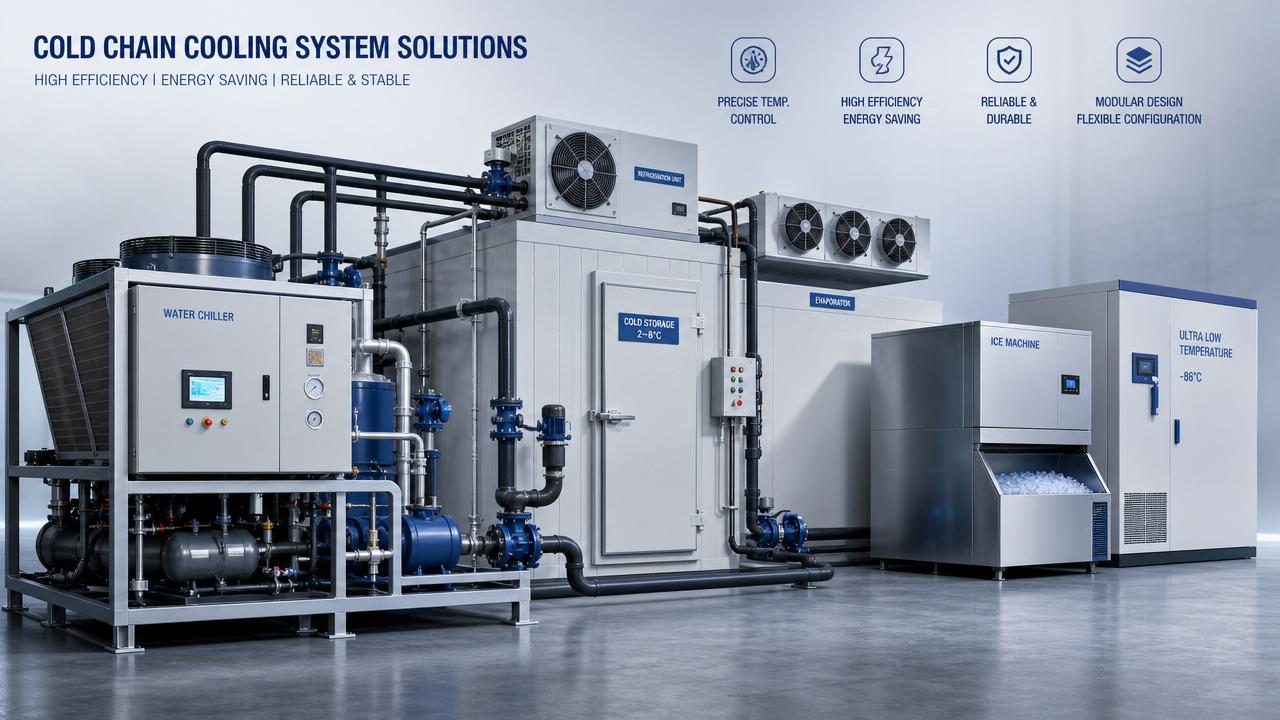
This matters across CCRS priority sectors. Industrial chillers may need stable leaving-water temperatures within ±0.5°C. Commercial refrigeration cabinets may focus more on airflow uniformity and defog performance. Ultra-low temperature freezers may need storage conditions at -86°C or below with alarm redundancy and recovery speed after door openings.
Define the operating profile first
Before comparing any temperature control systems, document the exact duty profile. Buyers should confirm 6 core inputs: target temperature range, load fluctuation, ambient conditions, operating hours, product sensitivity, and utility limitations. Without these details, technical comparison becomes guesswork.
- Temperature range: for example, 2°C to 8°C, -18°C to -25°C, or -40°C to -86°C
- Load pattern: constant, peak-shifted, batch process, or door-opening intensive
- Ambient conditions: indoor machine room, hot climate above 40°C, or coastal corrosion exposure
- Operating schedule: 8 hours, 16 hours, or 24/7 duty cycle
- Criticality: product comfort cooling versus regulated pharmaceutical or biologic storage
- Power conditions: stable voltage, limited backup power, or generator-supported site
A system sized for average demand may fail during peak summer conditions or defrost cycles. Conversely, an oversized unit can create unnecessary capital cost and short cycling. In many facilities, a 10% to 20% sizing margin is reasonable, but extreme oversizing often increases energy waste and control instability.
Use a weighted scorecard instead of unit price alone
A practical sourcing model is to weight technical and commercial factors. For example, some buyers assign 30% to thermal performance, 25% to energy use, 20% to compliance and refrigerant suitability, 15% to maintenance and parts access, and 10% to upfront price. The exact weighting changes by application, but the method improves decision quality.
The table below shows a comparison structure that procurement teams can use when reviewing temperature control systems across industrial, commercial, and cold-chain applications.
The key takeaway is simple: two temperature control systems with similar nominal capacity can perform very differently once part-load behavior, ambient stress, and serviceability are included. Procurement should therefore compare total operating reality, not just nameplate data.
Compare the technical factors that truly affect performance
A sound technical review helps buyers separate marketing claims from operational value. In refrigeration and cooling environments, performance is shaped by control precision, heat exchange efficiency, compressor behavior, defrost management, insulation integrity, and monitoring capability. These are the details that influence uptime over thousands of operating hours.
Temperature stability is more important than nominal setpoint
Procurement teams often focus on whether a unit can reach a target temperature, but the more useful question is how steadily it can hold that target. For chilled production water, a tolerance of ±0.5°C may be critical. For vaccine or biological storage, tighter alarm management and documented recovery time can be more important than a simple display reading.
Ask suppliers to provide performance data at minimum 3 operating conditions: rated ambient, high ambient, and part-load operation. If a cold storage compressor rack performs well only at full load, it may consume excessive energy during the 60% to 80% load range where many facilities spend most of the year.
Questions worth asking
- What is the temperature uniformity across the cabinet, room, or circulating loop?
- How long does the system need to pull down from ambient to operating setpoint?
- What is the temperature recovery time after a 30-second or 60-second door opening?
- How many sensors are used, and where are they installed?
Efficiency should be judged across the full operating profile
In industrial chillers, variable-frequency screw compressors and magnetic bearing technologies may improve part-load performance. In refrigeration cabinets, fan motor efficiency, air curtain design, and anti-fog heater control can heavily influence energy use. In ultra-low temperature systems, cascade design and insulation quality strongly affect power draw.
A system that appears 8% cheaper to buy may become 15% to 25% more expensive over 5 years if it runs continuously at lower efficiency. For procurement, it is useful to request annualized energy estimates based on site hours, climate, and product load rather than a single laboratory point.
Refrigerant strategy is now a purchasing issue, not only an engineering issue
Global refrigerant regulation is changing equipment selection. In many export and high-compliance markets, buyers need to consider whether the chosen temperature control systems align with phasedown rules, service gas availability, and future retrofit cost. CO2 transcritical systems, low-GWP blends, and natural refrigerant pathways are increasingly relevant in cold-chain and retail applications.
This does not mean one refrigerant fits every use case. Instead, procurement should ask whether the refrigerant supports the site’s temperature range, technician capability, safety requirements, and medium-term compliance horizon of 3 to 7 years.
Match the system type to the application environment
Different applications place different stress on temperature control systems. A buyer comparing equipment for a seafood cold room, a plastic injection plant, a supermarket display line, and a biomedical freezer room cannot rely on the same checklist alone. The operating context changes the decision logic.
Typical fit by application
The next table summarizes how common procurement priorities shift across major refrigeration and cooling scenarios linked to the CCRS industry scope.
This application-based view helps buyers avoid a common error: purchasing a technically capable system that is poorly suited to the actual thermal behavior of the site. Good application fit often has more value than headline capacity alone.
Look beyond the machine to the surrounding system
Temperature control systems do not operate in isolation. Piping layout, airflow obstruction, door discipline, insulation thickness, loading routines, and control integration can change delivered performance by 10% or more. Procurement teams should therefore evaluate the whole cooling system, not just the core unit.
For example, a well-selected cold room compressor may still struggle if evaporator placement is poor or if door openings exceed 100 cycles per shift. A high-efficiency cabinet may underperform if aisle temperature is too high or product loading blocks air return paths.
Assess lifecycle cost, maintenance, and supply risk
Procurement confidence improves when total cost of ownership is visible. That means accounting for energy use, preventive maintenance, spare parts access, expected downtime, training, and end-of-life refrigerant considerations. In many refrigeration projects, purchase price may represent only 30% to 50% of 5-year ownership cost.
Maintenance burden affects real operating cost
Ask suppliers for maintenance intervals in measurable terms. Condenser cleaning may be needed every 1 to 3 months in dusty industrial sites, while filter replacement schedules can vary by application. Alarm history access, remote monitoring, and modular parts replacement can significantly reduce service time.
A lower-cost system that requires 6 service visits per year may be less attractive than one needing only 2 planned visits, especially in remote locations where technician mobilization is expensive. For ultra-low temperature storage and critical cold-chain hubs, downtime risk should be priced into evaluation.
Spare parts and lead time should be part of the tender review
Parts availability often becomes visible only after a breakdown. Buyers should confirm lead times for compressors, expansion valves, controller boards, sensors, and door gaskets. Typical spare part lead times can range from 48 hours for local stock to 4 to 8 weeks for imported components.
- Request a critical spare parts list before purchase approval.
- Ask which components are standard and which are custom-order items.
- Confirm local service coverage and response windows, such as 24 hours or 72 hours.
- Check whether firmware, controller settings, and alarm logs are easy to access.
Compare lifecycle cost with a simple decision model
Even without advanced software, procurement can compare temperature control systems using a 5-year model. Include purchase price, estimated annual electricity use, planned maintenance cost, unplanned downtime risk allowance, and probable compliance retrofit exposure. This creates a clearer business case than focusing on initial capex.
Procurement checklist for a confident final decision
Once technical screening is complete, procurement should standardize final review. A disciplined closing checklist reduces the chance of missed assumptions, especially in cross-functional decisions involving engineering, operations, quality, and finance.
8-point buyer checklist
- Confirm required temperature band and allowable tolerance in writing.
- Review performance at full load, part load, and high ambient conditions.
- Verify refrigerant suitability for the next 3 to 7 years.
- Check annual energy estimate based on real operating hours.
- Request maintenance interval and service task list.
- Confirm spare parts lead time and technical support coverage.
- Review alarm, monitoring, and data logging capabilities.
- Align acceptance criteria, commissioning scope, and training needs.
Common sourcing mistakes to avoid
The most frequent mistakes are comparing different design assumptions, ignoring part-load efficiency, overlooking refrigerant transition risk, and failing to define acceptance tests. In cold-chain and refrigeration projects, these oversights can delay commissioning by 2 to 6 weeks or create recurring operating cost issues throughout the asset life.
Confident procurement comes from disciplined comparison, not from choosing the most familiar vendor or the lowest initial price. When buyers evaluate temperature control systems using clear thermal, regulatory, maintenance, and application criteria, they reduce uncertainty and improve operational resilience.
For organizations working across industrial chillers, commercial ice machines, cold storage compressors, refrigeration cabinets, or ultra-low temperature freezers, CCRS-style intelligence can help turn a technical purchase into a long-term performance asset. To discuss your operating profile, compare system options, or get a tailored evaluation framework, contact us today to explore a solution that fits your cold-chain or industrial cooling requirements.
Recommended News
 Precision ChillersIndustrial Chillers: What Causes Performance Gaps in Summer?Analyst :Industrial Cooling Architect
 Precision ChillersWhat to compare before buying energy efficient chillersAnalyst :Industrial Cooling Architect
 Precision Chillers2026 China Refrigeration Expo Concludes: Liquid Cooling for Data Centers Gains Global AttentionAnalyst :Industrial Cooling Architect
 Precision ChillersWhat defines energy efficient cooling in real projectsAnalyst :Industrial Cooling Architect
 Precision ChillersUS Court Rules Trump-Era Global Tariffs Lack Legal BasisAnalyst :Industrial Cooling Architect
 Precision ChillersHow to compare temperature control systems with confidenceAnalyst :Industrial Cooling Architect
 Precision ChillersWhy does temperature control fail in precision cooling?Analyst :Industrial Cooling Architect
 Precision ChillersTemperature Control Systems for Process Cooling: Key Specs to CompareAnalyst :Industrial Cooling Architect
![]() Precision ChillersIndustrial Cooling System Selection: Air-Cooled vs Water-Cooled vs EvaporativeAnalyst :Industrial Cooling Architect
Precision ChillersIndustrial Cooling System Selection: Air-Cooled vs Water-Cooled vs EvaporativeAnalyst :Industrial Cooling Architect Precision ChillersLiquid Cooling Parts Draw Middle East Interest at Shanghai ShowAnalyst :Industrial Cooling Architect
 Precision ChillersUS Probe Into Chinese CBS Raises Sealing Supply Chain ConcernsAnalyst :Industrial Cooling Architect
 Precision ChillersWhat Is Industrial Cooling? Main System Types and How to Choose by LoadAnalyst :Industrial Cooling Architect
 Precision ChillersEnergy Efficient Chillers vs Standard Chillers: What Buyers Should Compare Before PurchaseAnalyst :Industrial Cooling Architect
 Precision ChillersHow to Choose Industrial Chillers for Process Cooling: Capacity, Accuracy, and EfficiencyAnalyst :Industrial Cooling Architect
 Precision ChillersIndustrial Cooling Problems: 7 Common Causes of Unstable Temperature and Low CapacityAnalyst :Industrial Cooling Architect
 Precision ChillersHow to Size Industrial Chillers for Process Cooling: Load, Flow, and Temperature BasicsAnalyst :Industrial Cooling Architect
 Precision ChillersHow to Choose Industrial Chillers: Capacity, Temperature Range, and Cooling MethodAnalyst :Industrial Cooling Architect
 Precision ChillersHow to Choose Energy Efficient Chillers: COP, Load Profile, and Cooling Capacity ExplainedAnalyst :Industrial Cooling Architect
 Precision ChillersHow to Size Industrial Chillers for Process Cooling: Load, Flow Rate, and Temperature GuideAnalyst :Industrial Cooling Architect
 Precision ChillersIndustrial Process Cooling: How to Match Cooling Load to the Right SystemAnalyst :Industrial Cooling Architect
 Precision ChillersHow to Compare Commercial Energy Efficient Chiller Systems Price by Load and ROIAnalyst :Industrial Cooling Architect
 Precision ChillersHow to Compare Energy Efficient Chillers with Variable Speed for Process Cooling LoadsAnalyst :Industrial Cooling Architect
 Precision ChillersRed Sea Disruption Lifts Asia-Europe Freight 42%Analyst :Industrial Cooling Architect
 Precision ChillersHow to Choose Air Cooled Chillers with Variable Speed for Stable Load ControlAnalyst :Industrial Cooling Architect
 Precision ChillersRed Sea Disruption Pushes Asia-Europe Freight Up 42%Analyst :Industrial Cooling Architect
 Precision ChillersHow to Evaluate an Energy Efficient Chillers Supplier for Industrial ProjectsAnalyst :Industrial Cooling Architect
 Precision ChillersInjection Molding Cooling Systems ISO Requirements: What to Check Before ApprovalAnalyst :Industrial Cooling Architect
 Precision ChillersHow to Choose Low-Noise Laser Cooling Systems for Precision LabsAnalyst :Industrial Cooling Architect
![]() Precision ChillersInjection Molding Cooling Systems Variable Speed: Where Energy Savings Actually Come FromAnalyst :Industrial Cooling Architect
Precision ChillersInjection Molding Cooling Systems Variable Speed: Where Energy Savings Actually Come FromAnalyst :Industrial Cooling Architect Precision ChillersIndustrial Chillers for Glycol Systems: What Capacity, Temperature Range, and Flow Rate Matter Most?Analyst :Industrial Cooling Architect
 Precision ChillersEU Opens Subsidy Probe Into China Precision ChillersAnalyst :Industrial Cooling Architect
 Precision ChillersIndustrial Injection Molding Cooling Systems: How to Size Flow, Temperature, and LoadAnalyst :Industrial Cooling Architect
 Precision ChillersTemperature Control Units vs Temperature Control Devices: What’s the Difference in Industrial Use?Analyst :Industrial Cooling Architect
 Precision ChillersCopper Spike Extends Precision Chiller Lead Times to 14 WeeksAnalyst :Industrial Cooling Architect
 Precision ChillersHow Inverter Control Improves Industrial Chiller Efficiency and Load StabilityAnalyst :Industrial Cooling Architect
 Precision ChillersHow to Compare an Energy Efficient Chillers Exporter on COP, Controls, and Lifecycle CostAnalyst :Industrial Cooling Architect
 Precision ChillersHow to Evaluate a Laser Cooling Systems Factory: Key Capabilities, Quality Checks, and Lead TimesAnalyst :Industrial Cooling Architect
 Precision ChillersHow to Size Industrial Chiller Systems for Process Cooling Loads and Ambient ConditionsAnalyst :Industrial Cooling Architect
 Precision ChillersWhat Affects Heat Exchange Efficiency in Chillers and How to Improve It?Analyst :Industrial Cooling Architect
 Precision ChillersHow to Evaluate Secure Access Features in Stem Cell Cryogenic Storage Systems?Analyst :Industrial Cooling Architect