Industry News
Curation by industry experts
Hot Articles
- Thermodynamic Tech TrendsHow to Size Heat Exchange Systems for Refrigeration Plants at Peak Load
- Parallel Compressor RacksHow to Size Reciprocating Compressors for Cold Storage Load and Temperature Range
- Flake Ice MachinesHow to Size a Commercial Ice Dispenser for Peak Demand in Foodservice Operations
Popular Tags
What limits heat exchange efficiency in real systems?
In real refrigeration and cold-chain systems, heat exchange efficiency is rarely limited by one component alone.
It is shaped by refrigerant properties, surface fouling, airflow distribution, compressor control, load variability, and the gap between ideal thermodynamics and field operation.
Understanding these constraints helps evaluate chillers, cold storage plants, display cabinets, ice machines, and ultra-low temperature freezers with greater accuracy.
What does heat exchange efficiency mean in real systems?
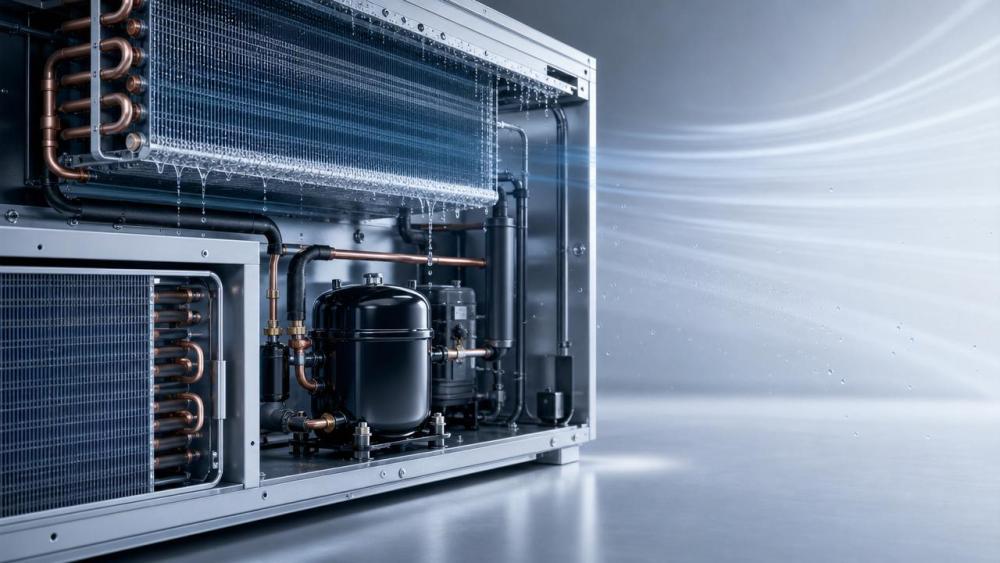
Heat exchange efficiency describes how effectively equipment moves heat between two media under actual operating conditions.
In refrigeration, it often means how well evaporators absorb heat and condensers reject heat.
The ideal reversed Carnot cycle assumes perfect transfer, no pressure loss, and stable temperatures.
Real systems face metal resistance, refrigerant behavior, oil films, ice, dust, airflow gaps, and changing loads.
Therefore, heat exchange efficiency is not just a laboratory number.
It is a field performance indicator linked to energy cost, temperature stability, compressor stress, and product preservation.
Why does the definition vary by application?
A food cold room values steady pull-down and uniform product temperature.
A laser chiller values fast response and precise outlet water control.
An ultra-low temperature freezer values stable cascade operation and safe heat rejection.
Each case measures heat exchange efficiency through different practical outcomes.
Why does refrigerant choice limit heat exchange efficiency?
Refrigerants decide pressure level, latent heat, density, viscosity, thermal conductivity, and glide behavior.
These properties directly affect heat exchange efficiency inside evaporator and condenser passages.
CO2 systems can deliver strong heat transfer because of high volumetric capacity and favorable flow properties.
However, transcritical operation needs careful gas cooler design and pressure optimization.
Ammonia offers excellent thermodynamic performance, but safety, charge control, and material compatibility shape design choices.
HFO blends may reduce environmental impact, yet temperature glide can complicate evaporator matching.
What should be checked before changing refrigerants?
- Heat exchanger surface area and allowable pressure rating.
- Compressor envelope, oil compatibility, and discharge temperature.
- Expansion valve capacity and control algorithm suitability.
- Defrost strategy, superheat stability, and low-load behavior.
- Regional compliance rules, including F-Gas and safety codes.
A refrigerant retrofit can improve heat exchange efficiency only when the entire circuit supports the new operating profile.
Otherwise, a low-GWP selection may create unstable control or higher compressor energy.
How do fouling, frost, and oil films reduce heat exchange efficiency?
Surface condition is one of the most common field limits on heat exchange efficiency.
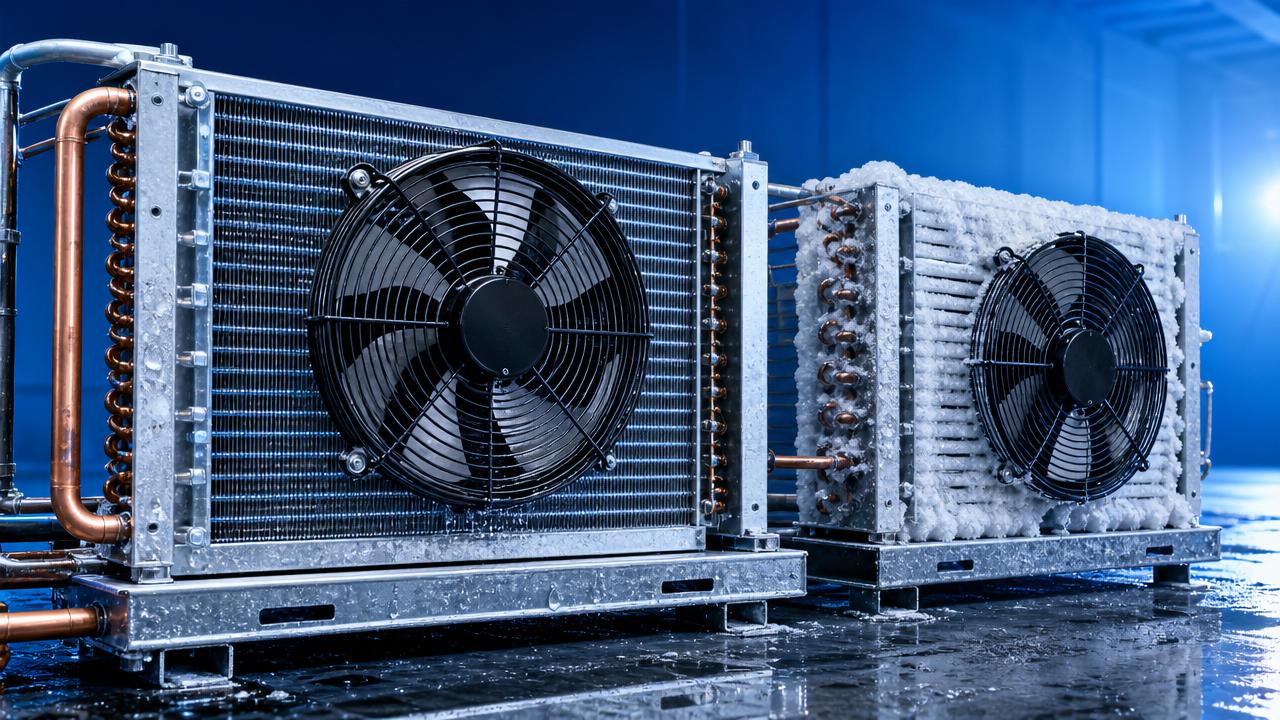
Dust on condenser fins blocks air and adds thermal resistance.
Scale in water-cooled chillers reduces tube-side heat transfer and increases approach temperature.
Frost on evaporators initially adds surface area, but quickly becomes an insulating layer.
Oil retained in evaporators forms a thin film that blocks refrigerant contact with metal surfaces.
Where is fouling most damaging?
Commercial refrigeration cabinets are sensitive because air curtains require clean coils and balanced airflow.
Cold storage evaporators are exposed to moisture, packaging fibers, and door infiltration.
Industrial chillers face mineral deposits when water treatment is weak.
Ice machines suffer from water impurities that affect plate or tube surfaces.
What maintenance actions protect performance?
- Track approach temperature trends, not only alarm events.
- Clean condenser coils before peak ambient seasons.
- Use water treatment for evaporative condensers and chillers.
- Verify oil return in low-temperature and long-pipe systems.
- Optimize defrost timing through sensor feedback, not fixed schedules.
Clean surfaces preserve heat exchange efficiency and reduce unnecessary compressor lift.
Can airflow and fluid distribution become the hidden bottleneck?
Even a high-quality heat exchanger can perform poorly when flow distribution is uneven.
Air bypass, blocked fins, weak fans, and poor duct geometry lower heat exchange efficiency.
In cold rooms, stacked pallets may block return air and create warm zones.
In retail cabinets, disturbed air curtains allow ambient moisture and heat to enter.
In condensers, recirculated hot air raises condensing pressure and reduces system capacity.
What signs indicate distribution problems?
- Large temperature differences across the same room or cabinet.
- Frequent short cycling despite normal refrigerant charge.
- High compressor head pressure during moderate weather.
- Frost forming unevenly on evaporator sections.
- Product temperature complaints without controller alarms.
These symptoms often look like control faults, yet the root cause may be poor heat transfer access.
Correcting airflow paths can improve heat exchange efficiency without replacing major components.
How do compressors and controls affect heat exchange efficiency?
Compressors do not exchange heat directly, yet they strongly influence the temperature difference driving heat transfer.
Excessive condensing pressure forces the system to work across a larger temperature lift.
Very low suction pressure may increase evaporator temperature difference, but it can reduce overall efficiency.
Variable-frequency screws, scroll racks, and magnetic bearing chillers improve matching between load and capacity.
Better matching stabilizes evaporating temperature and supports higher heat exchange efficiency.
Why can oversized equipment underperform?
Oversized compressors may cycle frequently and keep evaporators outside stable operating conditions.
Oversized fans may create noise, air spill, or unnecessary electric load.
Oversized coils help only when refrigerant distribution and controls remain stable.
Balanced design is usually more valuable than simply selecting larger components.
Which control functions matter most?
- Floating head pressure control in suitable ambient conditions.
- Adaptive superheat control for stable evaporator utilization.
- Demand-based defrost for moisture-heavy environments.
- Compressor sequencing based on part-load efficiency.
- AI-assisted anomaly detection using temperature and pressure trends.
Controls convert equipment potential into actual heat exchange efficiency over changing seasons and loads.
What practical indicators reveal weak heat exchange efficiency?
Field evaluation should connect thermodynamic data with operating symptoms.
One measurement rarely explains total heat exchange efficiency.
A useful assessment combines temperatures, pressures, flow rates, energy consumption, and product stability.
This table helps separate heat exchanger limitations from compressor, control, and operating problems.
How can systems improve heat exchange efficiency over the lifecycle?
Lifecycle improvement starts before installation and continues through commissioning, monitoring, and maintenance.
Design should avoid narrow temperature approaches that become fragile under fouling or hot weather.
Commissioning should verify charge, airflow, water flow, expansion control, and sensor calibration.
Operations should track trends rather than wait for alarms.
Recommended improvement sequence
- Benchmark current energy use and temperature stability.
- Inspect coils, filters, fans, pumps, and water quality.
- Measure evaporating and condensing temperatures under normal load.
- Compare actual approach temperatures with design values.
- Optimize controls before replacing major hardware.
- Upgrade heat exchangers, fans, or compressors when data supports it.
This sequence prevents unnecessary capital spending and targets the real limit on heat exchange efficiency.
Which upgrades usually deliver measurable gains?
- Microchannel or optimized fin-and-tube condensers for suitable applications.
- High-efficiency evaporators with improved refrigerant distribution.
- EC fans and variable-speed pumps for part-load conditions.
- Digital controllers with predictive defrost and floating setpoints.
- Natural refrigerant systems designed around pressure and safety requirements.
The best upgrade depends on load profile, ambient conditions, compliance targets, and service capability.
Key takeaway: what really limits heat exchange efficiency?
Real heat exchange efficiency is limited by combined resistance across refrigerant, metal, air, water, controls, and operating behavior.
A clean coil with poor airflow still wastes energy.
A premium refrigerant with weak control still underperforms.
A large condenser with hot air recirculation cannot deliver its rated capacity.
The practical answer is system integration, not component isolation.
For cold-chain hubs, industrial chillers, commercial cabinets, ice machines, and deep-cryogenic freezers, the next step is data-based diagnosis.
Review approach temperatures, pressure trends, airflow patterns, defrost records, and energy intensity before choosing upgrades.
That approach turns heat exchange efficiency from a theoretical promise into measurable reliability, lower carbon impact, and stronger lifecycle value.
Recommended News
 Thermodynamic Tech TrendsTemperature Control Problems That Quietly Ruin Product QualityAnalyst :Prof. Sarah Lin
 Thermodynamic Tech TrendsHow heat exchange technology shapes system reliabilityAnalyst :Prof. Sarah Lin
 Thermodynamic Tech TrendsAus Scientists Break Through Anhydrous Proton-Conducting MembraneAnalyst :Prof. Sarah Lin
 Thermodynamic Tech TrendsHow variable frequency cooling cuts peak energy costsAnalyst :Prof. Sarah Lin
 Thermodynamic Tech TrendsHeat exchange technology flaws that raise operating costsAnalyst :Prof. Sarah Lin
 Thermodynamic Tech TrendsWhat makes eco-friendly cooling practical in daily use?Analyst :Prof. Sarah Lin
 Thermodynamic Tech TrendsWhat heat exchange technology cuts cooling energy wasteAnalyst :Prof. Sarah Lin
 Thermodynamic Tech TrendsLow carbon refrigeration is changing project planningAnalyst :Prof. Sarah Lin
 Thermodynamic Tech TrendsHeat Exchange Technology Is Changing Cooling DesignAnalyst :Prof. Sarah Lin
 Thermodynamic Tech TrendsWhat limits heat exchange efficiency in real systems?Analyst :Prof. Sarah Lin
 Thermodynamic Tech TrendsIndustrial Refrigeration System Selection: Key Capacity, Refrigerant, and Load FactorsAnalyst :Prof. Sarah Lin
 Thermodynamic Tech TrendsVariable Frequency Cooling Selection Guide: How to Match Load Range, COP, and Control StrategyAnalyst :Prof. Sarah Lin
 Thermodynamic Tech TrendsHeat Exchange Technology in Refrigeration: Which Design Improves Capacity and Defrost Efficiency?Analyst :Prof. Sarah Lin
![]() Thermodynamic Tech TrendsMagnetic Bearing Technology Explained: How Oil-Free Compression Improves Chiller EfficiencyAnalyst :Prof. Sarah Lin
Thermodynamic Tech TrendsMagnetic Bearing Technology Explained: How Oil-Free Compression Improves Chiller EfficiencyAnalyst :Prof. Sarah Lin Thermodynamic Tech TrendsVariable Frequency Cooling Explained: How It Improves Refrigeration Efficiency and Load ControlAnalyst :Prof. Sarah Lin
 Thermodynamic Tech TrendsHeat Exchange Efficiency: Which Design Factors Matter Most in Industrial Cooling?Analyst :Prof. Sarah Lin
 Thermodynamic Tech TrendsHeat Exchange Technology Comparison: Plate, Shell-and-Tube, or Microchannel?Analyst :Prof. Sarah Lin
 Thermodynamic Tech TrendsIndustrial Cooling Systems Explained: Which Setup Fits Food, Pharma, and Process Plants?Analyst :Prof. Sarah Lin
 Thermodynamic Tech TrendsVariable Frequency Cooling vs Fixed-Speed Systems: Which Cuts Energy Costs Better?Analyst :Prof. Sarah Lin
 Thermodynamic Tech TrendsTemperature Control Systems Explained: Key Components, Control Logic, and Common UsesAnalyst :Prof. Sarah Lin
 Thermodynamic Tech TrendsHow Heat Exchange Efficiency Affects Compressor Load and System StabilityAnalyst :Prof. Sarah Lin
 Thermodynamic Tech TrendsEnergy Saving Low Carbon Cooling: Which Metrics Actually Matter in System Evaluation?Analyst :Prof. Sarah Lin
 Thermodynamic Tech TrendsHow to Compare a Heat Transfer Technology Manufacturer for Custom Process Cooling ProjectsAnalyst :Prof. Sarah Lin
 Thermodynamic Tech TrendsChoosing an Industrial Cooling Systems Supplier: 7 Evaluation Criteria Before RFQAnalyst :Prof. Sarah Lin
 Thermodynamic Tech TrendsHeat Transfer Technology Air Cooler: Key Design Factors for Stable Cooling PerformanceAnalyst :Prof. Sarah Lin
 Thermodynamic Tech TrendsEnergy Efficient Refrigeration Systems with Heat Recovery: Where the Savings Really Come FromAnalyst :Prof. Sarah Lin
 Thermodynamic Tech TrendsWhat Determines Heat Exchange Technology Price in Industrial Cooling Projects?Analyst :Prof. Sarah Lin
 Thermodynamic Tech TrendsHow to Select Heat Exchange Plates for Corrosion Resistance and Thermal EfficiencyAnalyst :Prof. Sarah Lin
 Thermodynamic Tech TrendsHow Microchannel Heat Exchangers Improve Refrigeration System EfficiencyAnalyst :Prof. Sarah Lin
 Thermodynamic Tech TrendsHeat Transfer Technology for Blast Freezers: Speed, Efficiency, and DesignAnalyst :Prof. Sarah Lin
 Thermodynamic Tech TrendsHow to Size Heat Exchange Systems for Refrigeration Plants at Peak LoadAnalyst :Prof. Sarah Lin