Industry News
Curation by industry experts
Hot Articles
- Cold Chain & Retail Energy InsightsHow to Compare Energy Ratings in Specification-Led Refrigeration Equipment Guides
- Cold Chain & Retail Energy InsightsCold Chain Technology: How Sensors and Automation Prevent Temperature Excursions
- Cold Chain & Retail Energy InsightsHow North American Cold Facilities Can Benchmark Refrigeration System Efficiency
Popular Tags
Thermodynamic Technologies in Commercial Cooling: Which Heat-Rejection Method Fits?
Thermodynamic Technologies in Commercial Cooling: Which Heat-Rejection Method Fits?
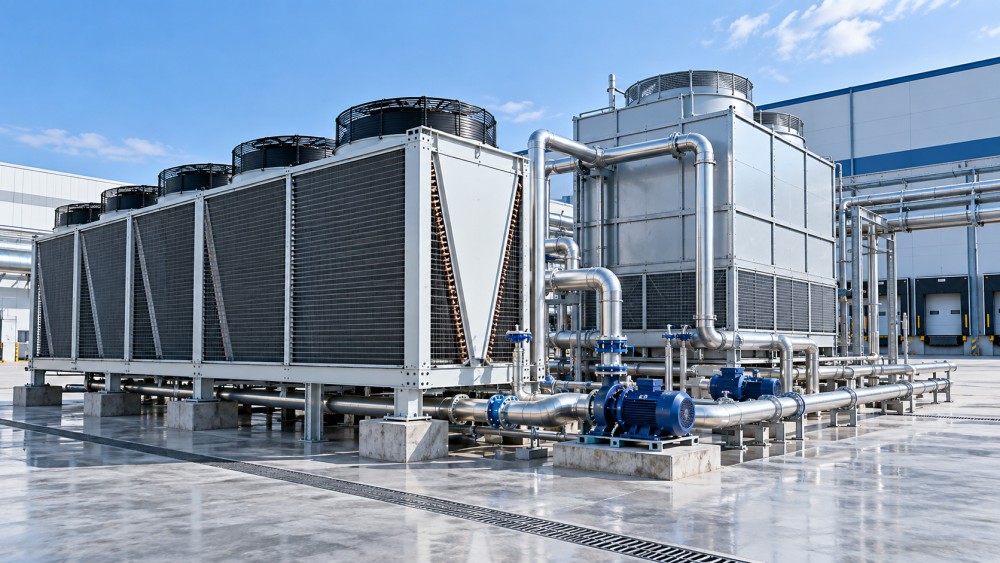
Selecting a heat-rejection method is not a secondary equipment choice. It determines condensing temperature, compressor power, water demand, maintenance exposure, resilience, and project economics.
For technical evaluators, the practical answer is straightforward: choose the method that delivers the lowest defensible lifecycle cost under actual site conditions, not idealized design assumptions.
Air-cooled, water-cooled, and evaporative systems can all perform well. Their suitability changes with climate, operating hours, refrigerant selection, load variability, water constraints, and compliance obligations.
Commercial cooling projects increasingly face competing objectives. Operators need reliable temperature control, lower electricity consumption, reduced refrigerant risk, manageable maintenance, and credible decarbonization performance.
Thermodynamic technologies provide the analytical framework for resolving those tradeoffs. The key is understanding where rejected heat goes, how much temperature lift the compressor must create, and what resources each option consumes.
Start With the Real Engineering Question
The wrong question is, “Which condenser type is most efficient?” The useful question is, “Which heat-rejection arrangement remains efficient and operable at this site?”
Every refrigeration system removes heat from a refrigerated space, product, process, or storage chamber. It must then reject both absorbed cooling load and compressor input energy.
That rejection occurs at the condenser, gas cooler, or equivalent heat-exchange component. Its operating temperature directly influences system pressure ratio, capacity, and electrical demand.
Lower heat-rejection temperatures generally reduce compressor work. However, achieving lower temperatures may require water treatment, cooling towers, pumps, larger heat exchangers, or stricter maintenance regimes.
Technical evaluators should therefore compare complete systems. A low condensing temperature has value only when the equipment, utilities, controls, and service model can sustain it.
Design-day ambient temperature alone is insufficient. A facility operating continuously through hot afternoons, humid nights, seasonal transitions, and partial-load periods requires annual performance analysis.
For cold storage hubs, supermarket refrigeration plants, industrial chillers, and ice-making systems, annual energy use often matters more than the nameplate efficiency recorded at one rating condition.
Product criticality must also shape the decision. A medical freezer plant or food distribution facility may prioritize redundancy and predictable operation above a marginal energy advantage.
Air-Cooled Condensers: Simple, Water-Free, and Climate-Sensitive
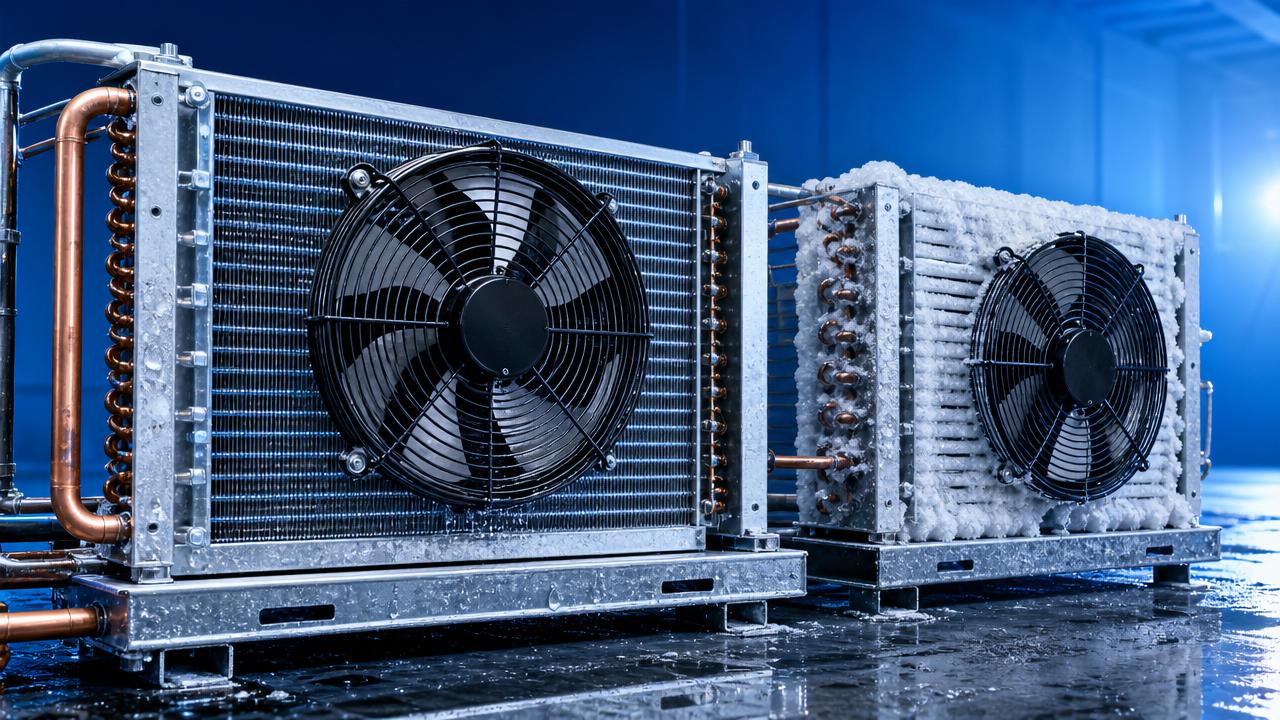
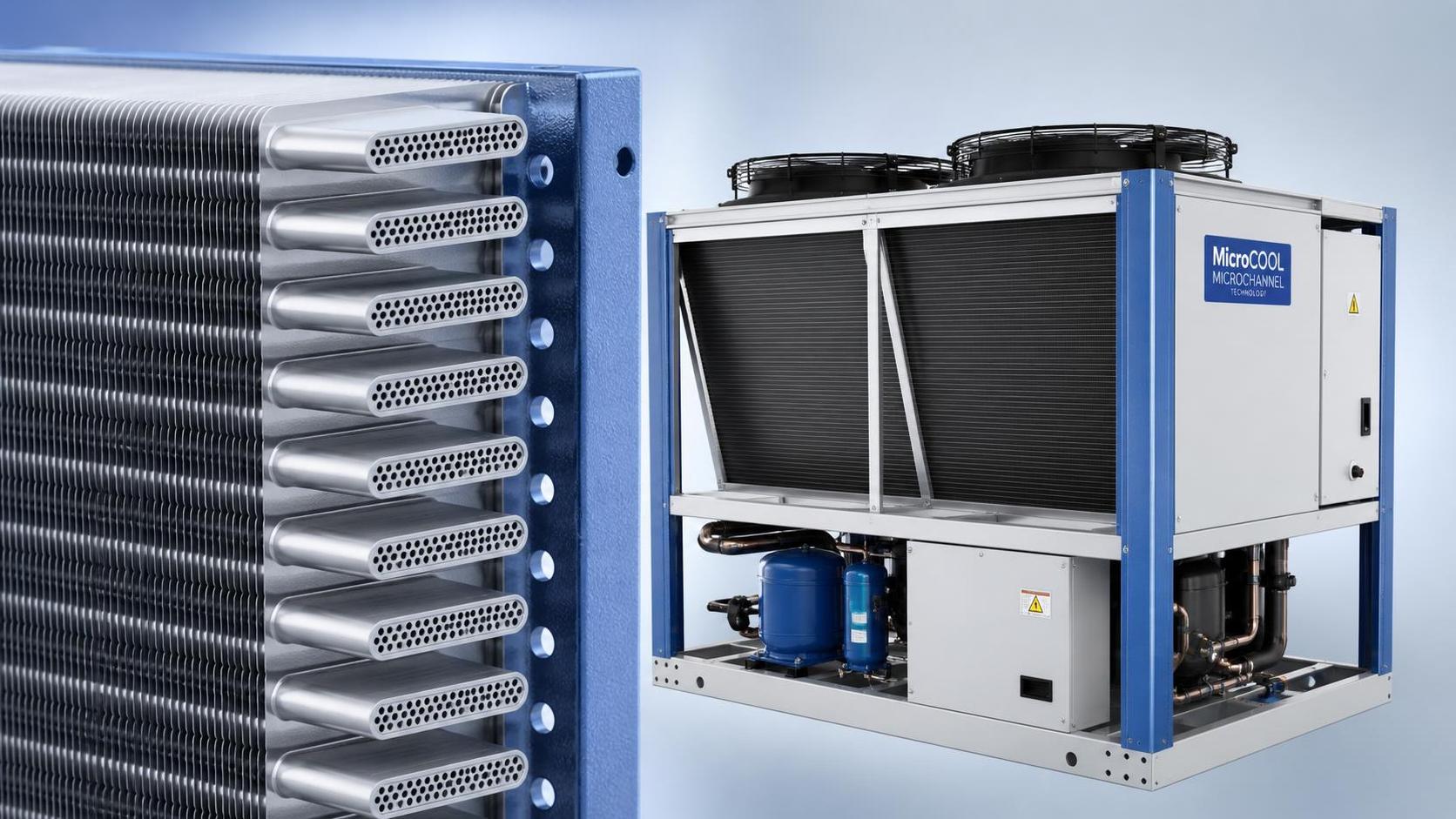
Air-cooled condensers reject heat directly to outdoor air through finned coils and fan-driven airflow. They are widely used because installation is relatively simple and water consumption is eliminated.
For many commercial refrigeration cabinets, condensing units, packaged chillers, and smaller cold rooms, air cooling offers a practical balance between capital cost and operational simplicity.
The principal limitation is ambient dry-bulb temperature. During hot weather, the condenser must operate above outdoor air temperature, increasing condensing pressure and compressor energy consumption.
Dust, grease, cottonwood, salt air, and blocked airflow compound this effect. Fouled coils can materially raise head pressure and reduce capacity when the refrigeration load is highest.
Air-cooled equipment works best where water is scarce, maintenance staffing is limited, heat loads are moderate, and local summer temperatures remain within a reasonable design envelope.
It also suits sites where cooling-tower permitting, water chemistry management, plume concerns, or Legionella risk would create unnecessary operating complexity.
Modern thermodynamic technologies improve air-cooled performance through electronically commutated fans, variable-speed controls, optimized fin geometry, floating head pressure, and intelligent compressor staging.
These measures can reduce fan energy and avoid excessive lift during mild weather. They do not remove the fundamental penalty imposed by high outdoor temperatures.
Evaluators should examine coil face area, fin spacing, fan redundancy, sound limits, service access, defrost interactions, and the expected capacity at site-specific peak ambient conditions.
They should also confirm whether rooftop placement will create recirculation. Hot discharge air drawn back into a condenser can make a properly sized unit behave like an undersized one.
Water-Cooled Systems: Stable Condensing Conditions With More Infrastructure
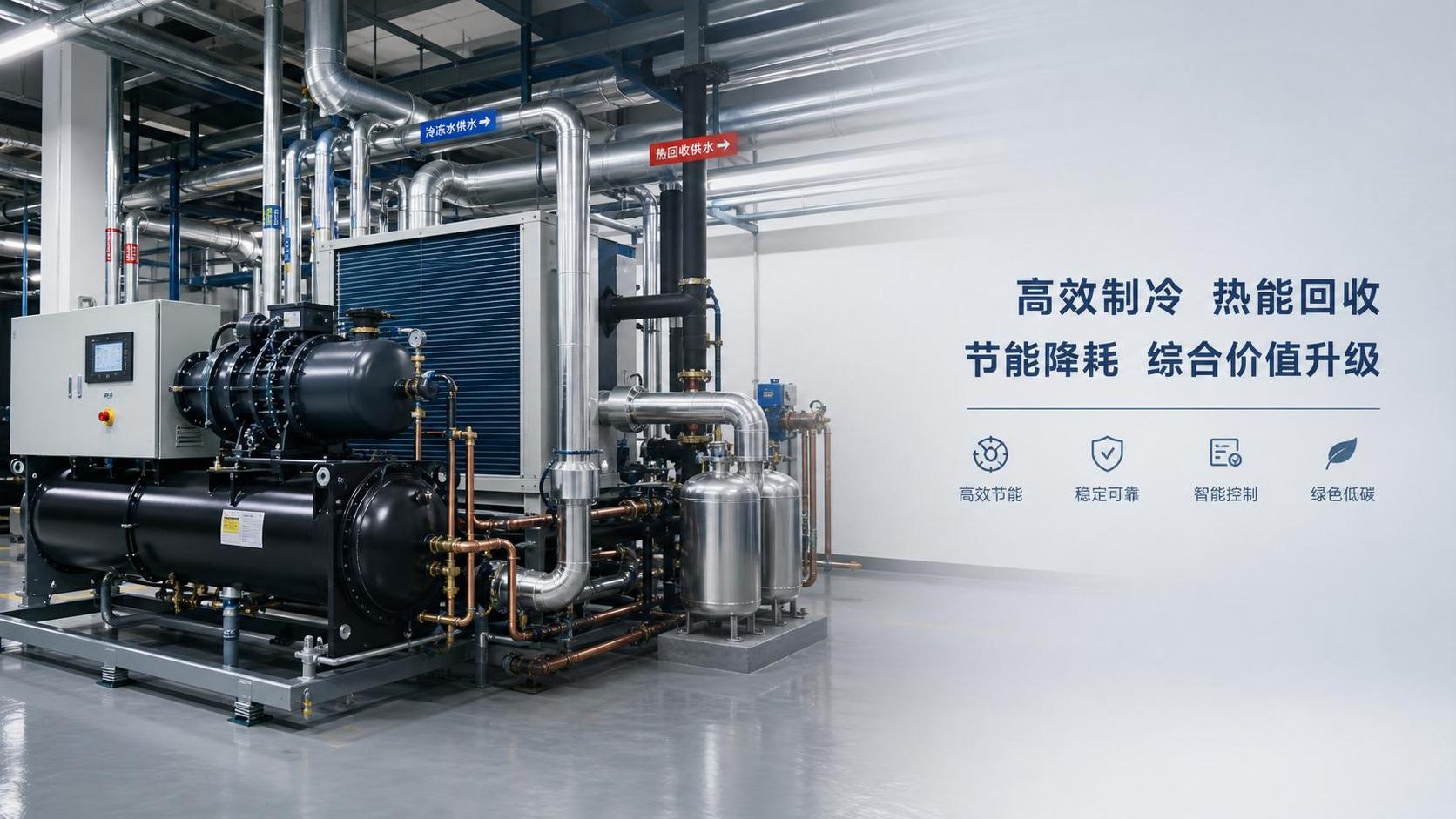
Water-cooled condensers transfer refrigerant heat into a water loop. That heat is usually discharged through a cooling tower, fluid cooler, geothermal loop, or central heat-recovery network.
The main advantage is stability. Water temperatures can often remain below peak outdoor dry-bulb conditions, allowing lower condensing temperatures and more consistent compressor efficiency.
This is especially valuable for large refrigeration racks, process chillers, high-duty ice plants, and facilities with substantial year-round loads.
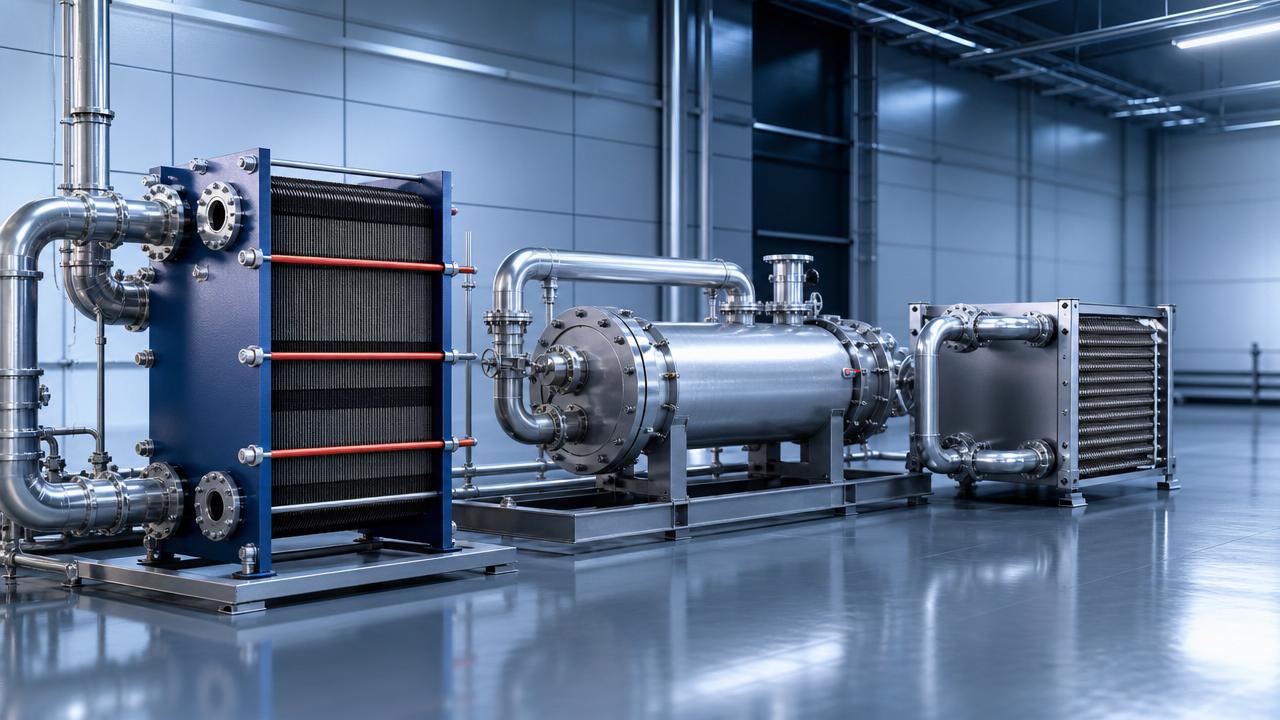
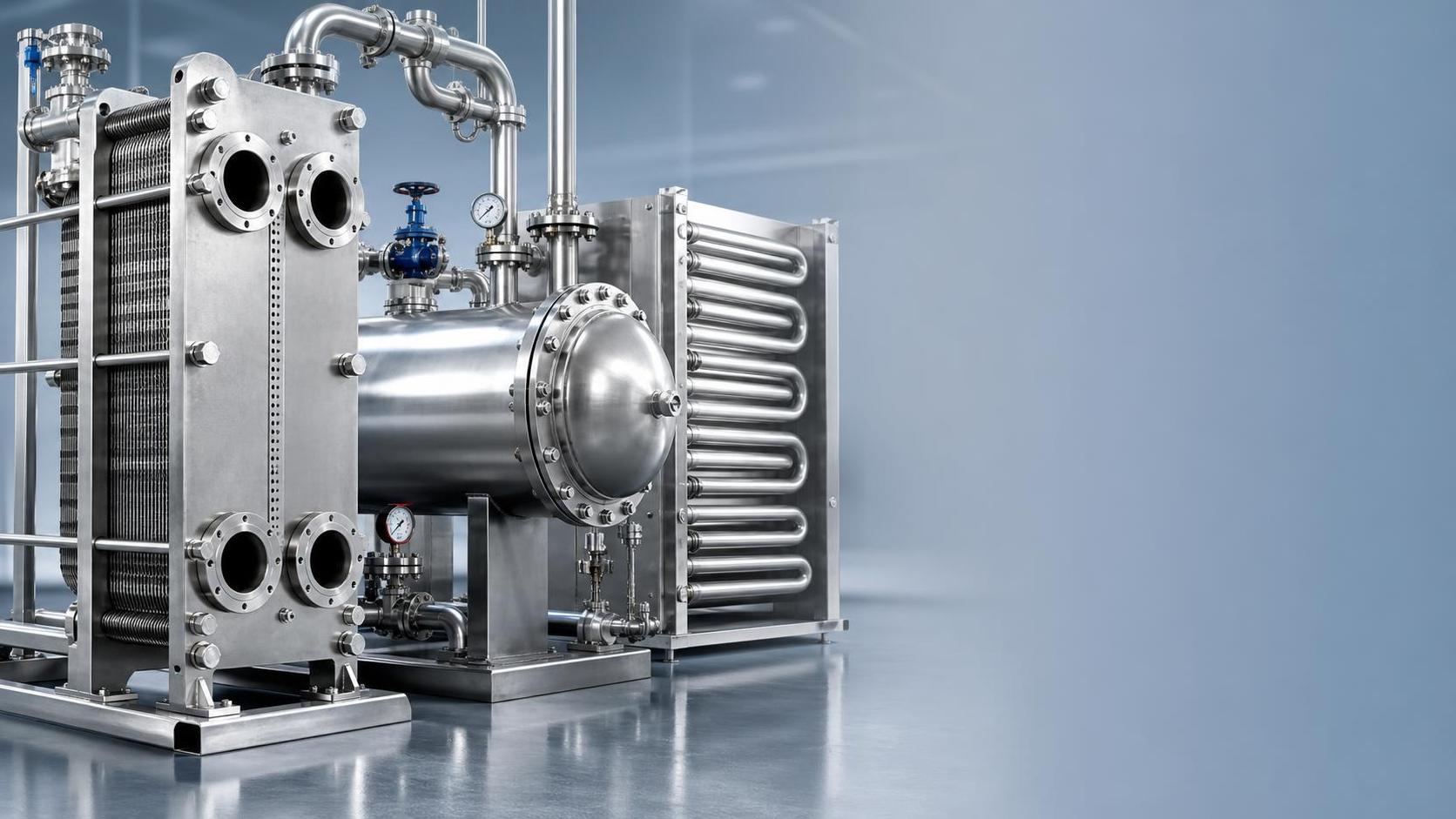
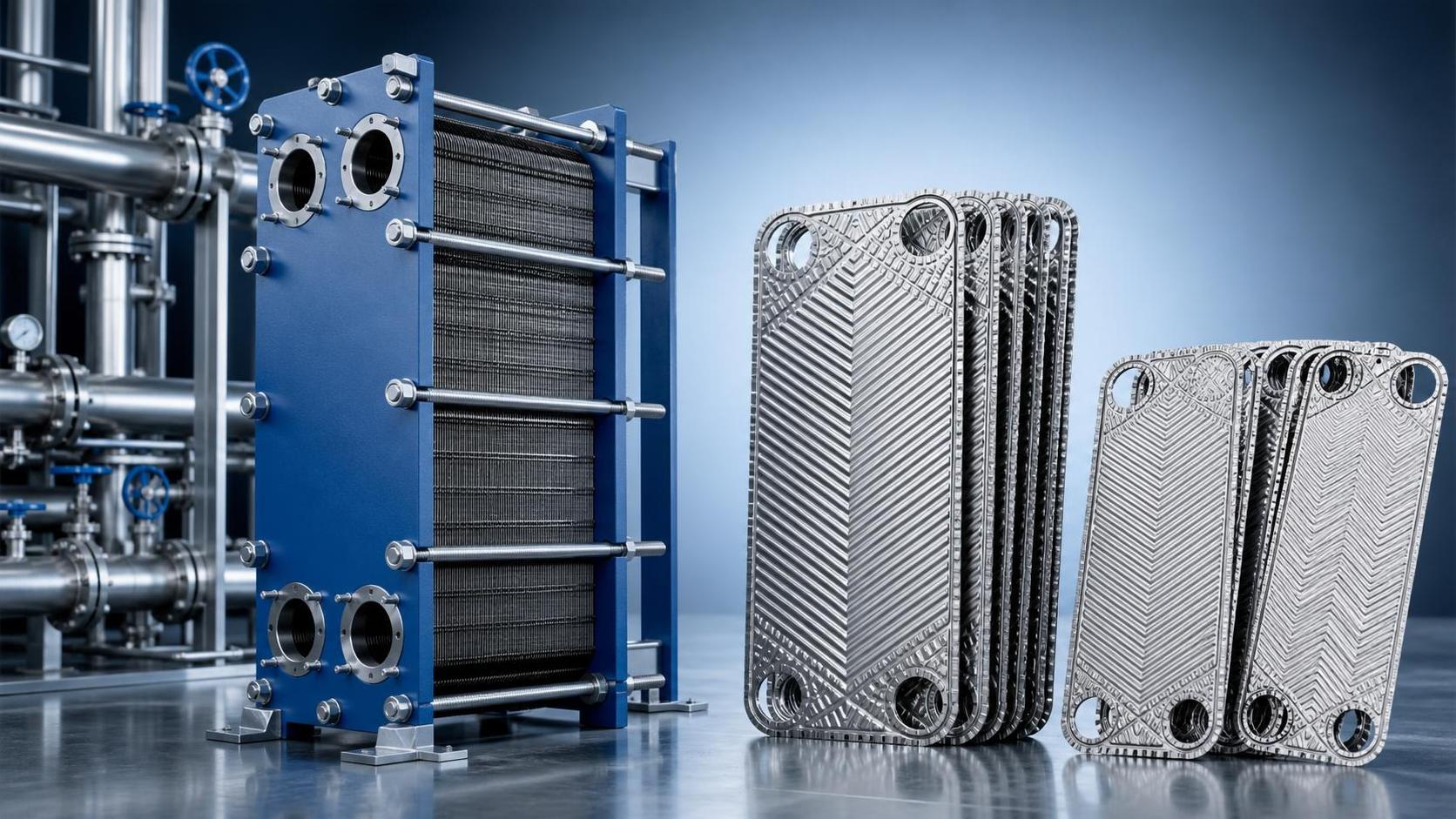
Water-cooled systems can support compact machine-room layouts because shell-and-tube or plate heat exchangers provide high heat-transfer performance within relatively small equipment footprints.
However, the apparent efficiency benefit must include pumps, tower fans, water treatment equipment, basin heaters, controls, and periodic cleaning requirements.
Water quality is a decisive issue. Scaling, corrosion, biological growth, and suspended solids reduce heat transfer and can damage condensers, valves, pumps, and tower components.
A weak water-treatment program can erase the energy advantage of a well-designed water-cooled plant. It may also create unplanned downtime and shortened equipment life.
Technical evaluations should account for makeup-water availability, sewer discharge charges, local drought restrictions, chemical handling rules, and service-provider capability before approving this approach.
Closed-circuit fluid coolers may reduce contamination risk because process fluid remains isolated. Yet they still require attention to heat-transfer surfaces, fan energy, freeze protection, and water-side hygiene.
Water-cooled designs are strongest where there is a skilled operating team, reliable water infrastructure, long annual operating hours, and enough capacity for efficiency savings to justify complexity.
Evaporative Heat Rejection: High Efficiency, High Discipline
Evaporative condensers and cooling towers exploit the difference between dry-bulb and wet-bulb temperature. Water evaporation can cool the heat-rejection surface below ambient dry-bulb conditions.
In hot, dry climates, this thermodynamic advantage can be substantial. Lower condensing temperatures reduce compressor lift and may improve capacity precisely when refrigeration demand rises.
Evaporative heat rejection is common in industrial refrigeration, large cold stores, distribution centers, process cooling, and large-scale ice production where loads justify dedicated utility management.
The relevant climate metric is wet-bulb temperature, not only outdoor air temperature. A location with high humidity may offer less evaporative benefit than its dry-bulb profile suggests.
Water use is the central tradeoff. Evaporation, drift, blowdown, and maintenance losses must be calculated against local water cost, restrictions, treatment requirements, and sustainability targets.
Evaporative equipment also requires a formal water-management program. Biological control, inspection schedules, cleaning procedures, drift elimination, and recordkeeping are operational necessities rather than optional extras.
Legionella risk must be addressed through design, treatment, maintenance, and regulatory compliance. Evaluators should verify responsibility boundaries between equipment suppliers, contractors, and facility operators.
Hybrid adiabatic systems can reduce water consumption by operating dry during cooler periods and applying water only when ambient conditions would otherwise impose high condensing temperatures.
That approach can improve annual efficiency while limiting water exposure. It also introduces additional controls, nozzles, filtration, seasonal maintenance, and potential mineral-deposit issues.
For projects pursuing aggressive energy targets, evaporative technology may be compelling. For lightly staffed sites with uncertain water governance, its operational requirements may outweigh its theoretical benefit.
Refrigerant Choice Changes the Heat-Rejection Decision
Heat rejection cannot be evaluated independently from refrigerant selection. Different refrigerants create different pressure levels, discharge temperatures, heat-transfer characteristics, safety requirements, and control strategies.
Ammonia systems commonly support industrial evaporative condensing arrangements because they offer strong thermodynamic efficiency, particularly in large-capacity refrigeration applications with experienced operators.
Carbon dioxide systems require separate consideration. Transcritical CO2 plants may reject heat through a gas cooler rather than a traditional condenser during high ambient conditions.
In warm climates, CO2 efficiency depends heavily on gas-cooler approach temperature, high-pressure control, parallel compression, ejectors, adiabatic assistance, and heat-recovery integration.
Air-cooled CO2 gas coolers can be effective in many regions. Yet technical evaluators should model peak conditions carefully rather than relying on performance assumptions derived from cooler climates.
Hydrocarbon refrigerants can offer high efficiency and low global warming potential in appropriately sized systems. Their flammability requires compliant charge limits, ventilation, electrical classification, and installation practices.
HFO and lower-GWP HFC blends may simplify some retrofit pathways, but their temperature glide, lubricant compatibility, capacity changes, and long-term regulatory position require careful assessment.
For ultra-low temperature freezers and cascade systems, the heat-rejection side affects the entire temperature cascade. Condenser performance can influence stability, pull-down time, and compressor operating limits.
Compliance teams should connect heat-rejection decisions with F-Gas rules, refrigerant availability, leak management, reporting obligations, and local environmental requirements from the earliest design stage.
Evaluate Annual Load Profiles Instead of Design Conditions Alone
A heat-rejection method should be selected using hourly or bin-based weather data whenever project scale justifies it. Peak design calculations cannot show annual energy behavior.
Commercial cooling loads vary with delivery schedules, door openings, product pull-down, occupancy, lighting, process production, defrost cycles, and ambient infiltration.
Cold storage facilities often experience sharp loading patterns. A system that performs acceptably at steady-state conditions may struggle during harvest peaks, loading bays, or blast-freezing operations.
Supermarkets and fresh-retail formats add another layer of variation. Refrigerated display cases interact with store HVAC systems, shopper traffic, lighting loads, and humidity control.
Industrial chillers may face fluctuating process loads from molding machines, laser cutting, fermentation, data equipment, or production line changes. Variable-speed capacity control becomes especially important.
Evaluate compressor maps, fan curves, pump curves, minimum turndown limits, and control sequences at part load. Many annual operating hours occur far below full design capacity.
Floating condensing pressure is one of the most valuable control strategies. When ambient conditions permit, lowering head pressure reduces compressor energy and often improves system capacity.
Its value depends on equipment coordination. Fans, valves, receivers, expansion devices, compressors, and safety controls must support stable operation across the intended pressure range.
Demand charges should also be included. A method that reduces peak compressor power during hot hours can have financial value beyond its annual kilowatt-hour savings.
A Practical Selection Framework for Technical Evaluators
Begin by defining the protected load. Identify required product temperatures, allowable excursion limits, pull-down expectations, storage capacity, process continuity needs, and the consequences of refrigeration failure.
Next, document local climate using dry-bulb, wet-bulb, humidity, solar exposure, wind patterns, and seasonal extremes. Use the actual equipment location, not a distant weather station.
Assess utility constraints early. Electricity tariff structure, water availability, wastewater costs, backup power, roof loading, drainage, noise restrictions, and site access may eliminate options quickly.
Then compare complete energy models. Include compressors, condenser or gas-cooler fans, pumps, cooling-tower fans, water-treatment systems, crankcase heaters, controls, and defrost-related impacts.
Calculate lifecycle cost rather than first cost alone. Consider procurement, installation, civil works, piping, electrical infrastructure, utility consumption, maintenance labor, chemicals, replacement parts, and downtime risk.
Use realistic assumptions for coil cleanliness and maintenance. A laboratory efficiency comparison loses meaning when the selected system will operate in dusty, neglected, or access-constrained conditions.
Review redundancy at the heat-rejection level. Multiple fans, isolated condenser cells, standby pumps, bypass arrangements, and emergency operating modes can protect temperature-critical inventory.
Confirm that the controls architecture supports alarms, remote monitoring, sensor validation, trend logging, and fault response. Digital visibility is essential for high-value cold-chain and biomedical operations.
Evaluate heat recovery before rejecting all available energy. Desuperheat and condensing heat can support domestic hot water, space heating, process washing, underfloor heating, or defrosting functions.
Heat recovery changes the economic equation. A water-cooled or CO2 system may gain additional value where usable heat demand coincides with refrigeration operation.
Finally, test supplier claims against guaranteed conditions. Request performance data at local ambient points, specified refrigerant conditions, fouling allowances, control modes, and expected load profiles.
Common Specification Errors That Distort Results
One common error is sizing only for the hottest hour. Excessively oversized air-cooled equipment can increase first cost, fan energy, cycling losses, and control instability during normal operation.
Another error is treating water as free. Evaporative systems should include water, sewer, chemical, testing, cleaning, treatment-contract, and compliance costs within the financial model.
Some projects compare compressor efficiency while ignoring auxiliary power. Pumping energy and cooling-tower fan energy can materially change the apparent advantage of water-cooled designs.
Ignoring future refrigerant regulation is equally risky. A technically functional system may become commercially unattractive if refrigerant supply, service expertise, or compliance costs change substantially.
Evaluators should avoid generic climate labels such as “hot” or “humid.” Quantified weather data, specific operating schedules, and site measurements produce much better decisions.
They should also challenge simplistic payback calculations. A short energy payback may still be unacceptable if reliability, water governance, safety obligations, or maintenance capability are weak.
How the Main Options Typically Fit
Air-cooled heat rejection usually fits decentralized commercial systems, water-constrained locations, smaller installations, and sites needing straightforward operation with limited specialist maintenance support.
Water-cooled systems often fit large, continuously operated plants with robust facility engineering resources, stable utility infrastructure, and opportunities for heat recovery or centralized plant optimization.
Evaporative condensers generally fit high-capacity facilities where wet-bulb conditions are favorable and disciplined water management can be maintained throughout the equipment lifecycle.
Adiabatic or hybrid solutions can fit projects seeking a compromise. They are useful where water use must be limited but peak summer electrical performance remains important.
For transcritical CO2 installations, the optimal solution depends strongly on climate and system architecture. Air cooling, adiabatic assistance, parallel compression, and heat recovery must be evaluated together.
No category should be selected solely because it is familiar. The best outcome comes from matching thermodynamic technologies to local constraints and measurable operational objectives.
Conclusion: Select the Lowest-Risk Efficient System
The most suitable heat-rejection method is the one that maintains required cooling temperatures with the lowest credible combination of energy, water, maintenance, compliance, and outage risk.
Air-cooled systems favor simplicity and water independence. Water-cooled and evaporative solutions can deliver lower condensing temperatures, but only when their infrastructure and operational disciplines are justified.
For technical evaluators, the decision should rest on site-specific climate data, annual load modeling, refrigerant strategy, utility constraints, lifecycle economics, and verified supplier performance.
When these factors are assessed together, commercial cooling projects can protect product quality while improving efficiency, reducing environmental exposure, and supporting long-term decarbonization goals.
Recommended News
 Thermodynamic Tech TrendsTemperature Control Problems That Quietly Ruin Product QualityAnalyst :Prof. Sarah Lin
 Thermodynamic Tech TrendsHow heat exchange technology shapes system reliabilityAnalyst :Prof. Sarah Lin
 Thermodynamic Tech TrendsAus Scientists Break Through Anhydrous Proton-Conducting MembraneAnalyst :Prof. Sarah Lin
 Thermodynamic Tech TrendsHow variable frequency cooling cuts peak energy costsAnalyst :Prof. Sarah Lin
 Thermodynamic Tech TrendsHeat exchange technology flaws that raise operating costsAnalyst :Prof. Sarah Lin
 Thermodynamic Tech TrendsWhat makes eco-friendly cooling practical in daily use?Analyst :Prof. Sarah Lin
 Thermodynamic Tech TrendsWhat heat exchange technology cuts cooling energy wasteAnalyst :Prof. Sarah Lin
 Thermodynamic Tech TrendsLow carbon refrigeration is changing project planningAnalyst :Prof. Sarah Lin
 Thermodynamic Tech TrendsHeat Exchange Technology Is Changing Cooling DesignAnalyst :Prof. Sarah Lin
 Thermodynamic Tech TrendsWhat limits heat exchange efficiency in real systems?Analyst :Prof. Sarah Lin
 Thermodynamic Tech TrendsIndustrial Refrigeration System Selection: Key Capacity, Refrigerant, and Load FactorsAnalyst :Prof. Sarah Lin
 Thermodynamic Tech TrendsVariable Frequency Cooling Selection Guide: How to Match Load Range, COP, and Control StrategyAnalyst :Prof. Sarah Lin
 Thermodynamic Tech TrendsHeat Exchange Technology in Refrigeration: Which Design Improves Capacity and Defrost Efficiency?Analyst :Prof. Sarah Lin
![]() Thermodynamic Tech TrendsMagnetic Bearing Technology Explained: How Oil-Free Compression Improves Chiller EfficiencyAnalyst :Prof. Sarah Lin
Thermodynamic Tech TrendsMagnetic Bearing Technology Explained: How Oil-Free Compression Improves Chiller EfficiencyAnalyst :Prof. Sarah Lin Thermodynamic Tech TrendsVariable Frequency Cooling Explained: How It Improves Refrigeration Efficiency and Load ControlAnalyst :Prof. Sarah Lin
 Thermodynamic Tech TrendsHeat Exchange Efficiency: Which Design Factors Matter Most in Industrial Cooling?Analyst :Prof. Sarah Lin
 Thermodynamic Tech TrendsHeat Exchange Technology Comparison: Plate, Shell-and-Tube, or Microchannel?Analyst :Prof. Sarah Lin
 Thermodynamic Tech TrendsIndustrial Cooling Systems Explained: Which Setup Fits Food, Pharma, and Process Plants?Analyst :Prof. Sarah Lin
 Thermodynamic Tech TrendsVariable Frequency Cooling vs Fixed-Speed Systems: Which Cuts Energy Costs Better?Analyst :Prof. Sarah Lin
 Thermodynamic Tech TrendsTemperature Control Systems Explained: Key Components, Control Logic, and Common UsesAnalyst :Prof. Sarah Lin
 Thermodynamic Tech TrendsHow Heat Exchange Efficiency Affects Compressor Load and System StabilityAnalyst :Prof. Sarah Lin
 Thermodynamic Tech TrendsEnergy Saving Low Carbon Cooling: Which Metrics Actually Matter in System Evaluation?Analyst :Prof. Sarah Lin
 Thermodynamic Tech TrendsHow to Compare a Heat Transfer Technology Manufacturer for Custom Process Cooling ProjectsAnalyst :Prof. Sarah Lin
 Thermodynamic Tech TrendsChoosing an Industrial Cooling Systems Supplier: 7 Evaluation Criteria Before RFQAnalyst :Prof. Sarah Lin
 Thermodynamic Tech TrendsHeat Transfer Technology Air Cooler: Key Design Factors for Stable Cooling PerformanceAnalyst :Prof. Sarah Lin
 Thermodynamic Tech TrendsEnergy Efficient Refrigeration Systems with Heat Recovery: Where the Savings Really Come FromAnalyst :Prof. Sarah Lin
 Thermodynamic Tech TrendsWhat Determines Heat Exchange Technology Price in Industrial Cooling Projects?Analyst :Prof. Sarah Lin
 Thermodynamic Tech TrendsHow to Select Heat Exchange Plates for Corrosion Resistance and Thermal EfficiencyAnalyst :Prof. Sarah Lin
 Thermodynamic Tech TrendsHow Microchannel Heat Exchangers Improve Refrigeration System EfficiencyAnalyst :Prof. Sarah Lin
 Thermodynamic Tech TrendsHeat Transfer Technology for Blast Freezers: Speed, Efficiency, and DesignAnalyst :Prof. Sarah Lin
 Thermodynamic Tech TrendsHow to Size Heat Exchange Systems for Refrigeration Plants at Peak LoadAnalyst :Prof. Sarah Lin
 Thermodynamic Tech TrendsThermodynamic Technologies in Commercial Cooling: Which Heat-Rejection Method Fits?Analyst :Prof. Sarah Lin