Industry News
Curation by industry experts
Hot Articles
Popular Tags
Ammonia Refrigeration Heat Exchangers: Plate vs. Shell-and-Tube Selection
Plate heat exchangers are a strong candidate when ammonia inventory, installation space, and close temperature approaches drive the design. Shell-and-tube exchangers deserve preference when the duty requires mechanically cleanable passages, tolerance of difficult process fluids, or repair access that a particular plate construction cannot provide. Neither geometry guarantees better system efficiency: the result depends on refrigerant distribution, pressure drop, oil removal, and performance across the operating envelope.
The decisive comparison is therefore not “plates versus tubes” in isolation. It is a comparison between specific constructions performing the same duty, at the same boundary conditions, with equivalent allowances for fouling, control stability, maintenance, and safety.
Define the duty before comparing exchanger geometry
An ammonia evaporator cooling glycol is not selected on the same basis as an ammonia condenser rejecting heat to water. A cascade exchanger condensing carbon dioxide against evaporating ammonia introduces another pressure envelope and different consequences of internal leakage. Even within evaporator service, flooded, pumped-recirculation, and direct-expansion arrangements impose different requirements for distribution and liquid management.
A useful specification fixes more than refrigeration capacity. It establishes entering and leaving fluid temperatures, ammonia saturation conditions, process-fluid composition, permitted pressure losses, minimum operating load, and anticipated fouling. For condensing service, it must also identify any desuperheating and subcooling duty rather than treating the entire exchanger as an isothermal condenser.
Fluid properties must correspond to operating temperature and concentration. A glycol solution selected from water-based performance data can produce a misleading comparison because its viscosity affects heat transfer and pumping power. For a seasonal installation, the coldest fluid condition may be more demanding hydraulically than the nominal design point.
These conditions should be identical across bids. An exchanger offered at a lower ammonia evaporating temperature may appear smaller or less expensive while transferring the penalty to compressor energy consumption.
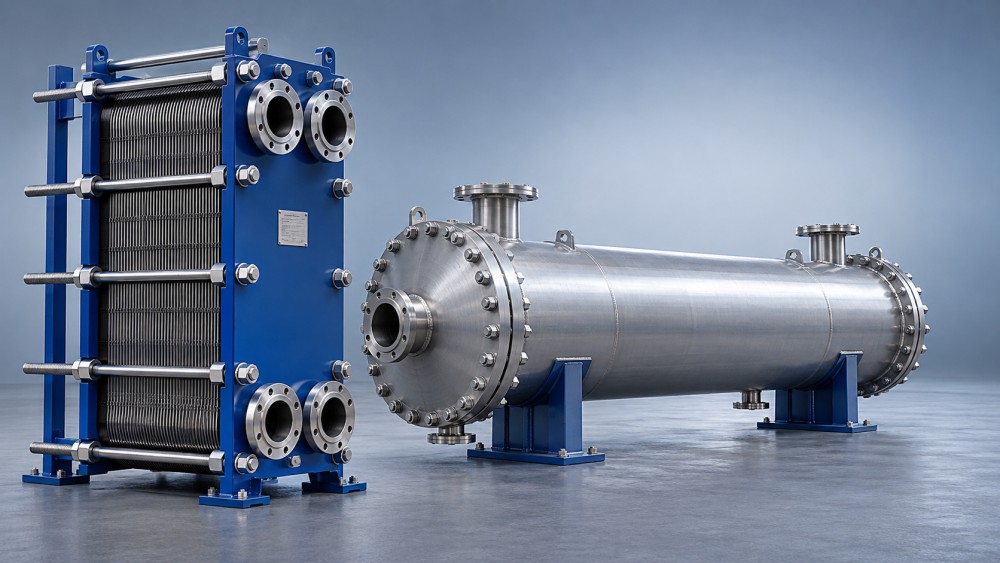
“Plate” and “shell-and-tube” each cover several different machines
For ammonia service, plate construction must be identified explicitly. Conventional copper-brazed plate exchangers are generally unsuitable because copper is incompatible with ammonia. An ammonia-rated welded or otherwise compatible brazed construction is a different proposition; suitability must be established for the actual materials, joining method, pressures, and temperatures.
Semi-welded plate exchangers contain welded plate pairs forming refrigerant channels, with gasketed passages between those pairs for the secondary fluid. This can provide access to the secondary-fluid surfaces, but it does not make the welded ammonia passages mechanically accessible. Fully welded designs further change the maintenance options, which vary with construction.
Shell-and-tube equipment also requires qualification. A flooded evaporator with ammonia on the shell side has different inventory and oil-management characteristics from a unit with ammonia inside the tubes. Fixed tubesheets, removable bundles, straight tubes, and U-tubes offer different access for inspection and cleaning.
Compare temperature approach and pressure drop together
Plate channels can generate high heat-transfer coefficients and support close temperature approaches. That can allow an evaporator to operate at a higher ammonia saturation temperature for a specified secondary-fluid outlet temperature, reducing compressor lift. In condenser service, a suitable thermal design can reduce the required condensing temperature.
However, a close approach is not an exclusive property of plate equipment. Shell-and-tube exchangers can also be designed for close approaches, with consequences for area, arrangement, and cost. The meaningful question is which design achieves the required temperatures within the available pressure-drop and installation limits.
The thermal relationship Q = U × A × ΔTlm explains why a high overall heat-transfer coefficient is only part of the answer. Effective temperature difference, flow arrangement, phase distribution, and fouling resistance also matter. For two-phase ammonia, a rating must account for the changing refrigerant condition through the exchanger rather than simply applying a single nominal coefficient.
Pressure losses can undermine an apparent efficiency advantage. On the evaporating side, refrigerant pressure drop changes the local saturation temperature and can increase the pressure lift required at the compressor. On the secondary side, higher resistance increases pumping demand. A compact exchanger that saves compressor power but requires substantially more pumping needs a combined energy assessment.
Request performance at design load, minimum sustained load, and relevant intermediate conditions. Specify whether pumps maintain constant flow or reduce speed. Turbulence, refrigerant distribution, and control behavior change with flow; a satisfactory full-load rating does not establish stable operation during turndown.
Low charge is valuable only when the complete circuit supports it
Reducing ammonia inventory can reduce the quantity available for release and may affect obligations tied to inventory thresholds in some jurisdictions. It does not remove ammonia’s toxicity hazard or the need for detection, isolation, ventilation, and pressure protection.
Compare total operating charge, not just exchanger internal volume. A low-volume plate core connected to a generously sized surge vessel and extensive liquid piping may deliver less inventory reduction than its standalone specification suggests. Conversely, a well-integrated package can retain the charge advantage by coordinating exchanger, separation, controls, and pipework.
The feed arrangement matters. Direct expansion requires effective refrigerant distribution and stable outlet control. Flooded and pumped-recirculation systems require appropriate liquid separation and circulation management. A geometry suitable for one arrangement should not be assumed to perform equally well in another without a specific rating.
Oil management belongs in the same evaluation. Lubricating oil carried into an ammonia evaporator can accumulate and impair heat transfer. Passage geometry, flow velocity, operating temperature, and refrigerant feed arrangement influence where it collects. Require the supplier to identify collection points, drainage provisions, and the behavior expected at low load. “Low charge” is not evidence of adequate oil removal.
Let contamination and maintenance access decide the difficult cases
For clean, treated glycol or brine in a closed circuit, narrow plate passages may be acceptable and their compactness valuable. For fluids carrying fibers, crystals, suspended solids, or deposits that resist chemical cleaning, the passage geometry can become a more important selection criterion than clean-surface thermal performance.
A shell-and-tube exchanger with the difficult fluid inside suitable straight tubes can provide mechanical cleaning access. That advantage disappears if the fouling fluid is placed on an inaccessible shell side or if the tube configuration prevents the required cleaning method. “Shell-and-tube is easier to clean” is therefore incomplete without a fluid-allocation and access drawing.
Semi-welded plate equipment offers a different maintenance compromise: opening the pack can expose the secondary-fluid side, while the welded refrigerant passages remain enclosed. Evaluate gasket replacement, plate handling, tightening procedures, and the checks required before restarting. Fully welded equipment may depend more heavily on chemical cleaning or specialized repair procedures.
Adding excess area is not a universal answer to fouling. If additional parallel passages reduce velocity, deposition can become more likely. The selection should connect fouling allowance to expected deposit behavior, cleaning intervals, and minimum flow—not merely add a conservative percentage to surface area.
Freezing protection also requires attention. Low secondary-fluid flow, incorrect glycol concentration, or unstable refrigerant control can create damaging local conditions. Neither geometry should be treated as freeze-proof. Verify minimum-flow protection, temperature limits, shutdown behavior, and restart conditions.
Check pressure integrity beyond normal operation
Materials must suit both ammonia and the secondary fluid. Carbon steel and suitable stainless steels are established options in ammonia equipment, but the exact grade and fabrication details still matter. Chloride-bearing water or brine can introduce corrosion risks for stainless steel, while cleaning chemicals can restrict gasket and material choices.
Design pressure cannot be selected from normal operating pressure alone. Standstill warming, defrost where applicable, blocked-in liquid expansion, pump pressure, and abnormal operating conditions must be considered. In cascade duties, evaluate each circuit separately and assess the consequences of leakage between them.
An internal leak may send ammonia into the secondary circuit or introduce secondary fluid into the refrigeration system, depending on the pressure differential at that moment. The assessment should include shutdown and upset conditions. Where contamination consequences are unacceptable, evaluate monitored intermediate barriers or another separation arrangement rather than assuming either geometry provides isolation by itself.
Applicable pressure-equipment and refrigeration requirements depend on the installation location. ASME pressure-vessel rules and the European Pressure Equipment Directive framework are examples of requirements that may apply; refrigeration safety standards also depend on jurisdiction and project scope. Require documentation for the actual supplied configuration, including allowable pressures and temperatures, materials, testing, and protection provisions.
Choose on the basis of recoverable performance, not initial cleanliness
Lifecycle cost should include compressor and pump energy, cleaning labor, consumables, spare components, repair lead time, and the cost of lost cooling. A small efficiency advantage can be outweighed by an outage that the site cannot accommodate.
Serviceability needs to be demonstrated physically. A removable bundle is of limited value without withdrawal space. An opening plate pack requires clearance, lifting access, and a safe maintenance procedure. A repairable design is useful only if replacement parts, qualified labor, and testing arrangements are available within the permitted outage.
Repair also changes performance. Plugging a leaking tube reduces active area and alters flow distribution. Replacing or modifying plate pairs must remain within the manufacturer’s approved configuration. Ask how the exchanger will be rerated after repair and what spare capacity remains, rather than treating repairability as a simple yes-or-no attribute.
For clean secondary-fluid cooling with restricted space and a meaningful ammonia-inventory target, an ammonia-rated plate design is a strong starting point. For duties dominated by solids, mechanical cleaning, or accessible tube-side repair, a suitably configured shell-and-tube exchanger may be the more defensible choice. Close temperature approaches or high pressure requirements alone do not settle the decision; both require construction-specific evaluation.
The final comparison should place guaranteed duty, pressure losses, operating charge, turndown limits, cleaning access, and post-repair capability on the same basis. The better heat exchange systems for ammonia refrigeration are those that preserve the required cooling performance under the site’s actual operating and maintenance constraints—not simply those with the smallest core or the highest clean-surface heat-transfer coefficient.
Recommended News
 Eco-Refrigerant & ComplianceF-Gas Regulations Are Changing Equipment Choices Faster Than ExpectedAnalyst :Dr. Henrik Weber
 Eco-Refrigerant & ComplianceEco-Friendly Refrigeration: What Looks Green but Performs Poorly?Analyst :Dr. Henrik Weber
 Eco-Refrigerant & ComplianceNatural Refrigerants: Are Compliance Benefits Worth the Transition Cost?Analyst :Dr. Henrik Weber
 Eco-Refrigerant & ComplianceWhat drives low carbon refrigeration adoption in 2026?Analyst :Dr. Henrik Weber
 Eco-Refrigerant & ComplianceEco-friendly cooling is changing compliance planning fastAnalyst :Dr. Henrik Weber
 Eco-Refrigerant & ComplianceLow carbon cooling trends that could reshape investmentsAnalyst :Dr. Henrik Weber
 Eco-Refrigerant & ComplianceHow F-Gas regulations are changing refrigerant decisionsAnalyst :Dr. Henrik Weber
 Eco-Refrigerant & ComplianceIs eco-friendly refrigeration worth the higher upfront costAnalyst :Dr. Henrik Weber
 Eco-Refrigerant & ComplianceWhy low carbon cooling is becoming a compliance priorityAnalyst :Dr. Henrik Weber
 Eco-Refrigerant & ComplianceLow carbon refrigeration options that cut long-term costsAnalyst :Dr. Henrik Weber
 Eco-Refrigerant & ComplianceWhat buyers miss when choosing eco-friendly refrigerationAnalyst :Dr. Henrik Weber
 Eco-Refrigerant & ComplianceWhy low carbon refrigeration is becoming a board issueAnalyst :Dr. Henrik Weber
 Eco-Refrigerant & ComplianceWhat F-Gas regulations mean for equipment choices in 2026Analyst :Dr. Henrik Weber
![]() Eco-Refrigerant & ComplianceIndonesia Launches Green Refrigeration Channel for R290 Cold CabinetsAnalyst :Dr. Henrik Weber
 Eco-Refrigerant & ComplianceWhy low carbon cooling is becoming a safer long betAnalyst :Dr. Henrik Weber
 Eco-Refrigerant & ComplianceWhat makes eco-friendly cooling cheaper over time?Analyst :Dr. Henrik Weber
 Eco-Refrigerant & ComplianceF-Gas regulations are changing how cooling gets approvedAnalyst :Dr. Henrik Weber
 Eco-Refrigerant & ComplianceHow eco-friendly refrigeration cuts compliance riskAnalyst :Dr. Henrik Weber
 Eco-Refrigerant & ComplianceHow low carbon cooling cuts compliance risk in 2026Analyst :Dr. Henrik Weber
 Eco-Refrigerant & ComplianceLow Carbon Refrigeration: Compare Refrigerants, Energy Use, and ComplianceAnalyst :Dr. Henrik Weber
 Eco-Refrigerant & ComplianceEco-Friendly Cooling Options: Refrigerants, Efficiency, and Compliance ChecksAnalyst :Dr. Henrik Weber
![]() Eco-Refrigerant & ComplianceWhat Are Natural Refrigerants? Types, GWP Limits, and Where They Fit BestAnalyst :Dr. Henrik Weber
 Eco-Refrigerant & ComplianceEco-Friendly Cooling vs Conventional Systems: What Buyers Should Compare FirstAnalyst :Dr. Henrik Weber
 Eco-Refrigerant & ComplianceEco-Friendly Refrigeration vs Conventional Systems: Refrigerants, Energy Use, and ComplianceAnalyst :Dr. Henrik Weber
 Eco-Refrigerant & ComplianceLow Carbon Refrigeration: Key Standards, Refrigerant Options, and ROI FactorsAnalyst :Dr. Henrik Weber
 Eco-Refrigerant & ComplianceTemperature Control Standards for Food Storage: Critical Limits, Logging, and Audit ChecksAnalyst :Dr. Henrik Weber
 Eco-Refrigerant & ComplianceLow Carbon Cooling Options Explained: Refrigerants, Compliance, and System Trade-OffsAnalyst :Dr. Henrik Weber
 Eco-Refrigerant & ComplianceDigital Refrigeration vs Conventional Controls: What Improves Monitoring and Compliance?Analyst :Dr. Henrik Weber
 Eco-Refrigerant & ComplianceLow Carbon Cooling Options for Commercial Refrigeration: CO2, Ammonia, and Hybrid SystemsAnalyst :Dr. Henrik Weber
 Eco-Refrigerant & ComplianceLow Carbon Cooling Options Compared: CO2, Ammonia, and HFO Systems for ComplianceAnalyst :Dr. Henrik Weber
 Eco-Refrigerant & ComplianceIndustrial Refrigeration Systems Buying Guide: Lifecycle Cost, Efficiency, and ComplianceAnalyst :Dr. Henrik Weber
 Eco-Refrigerant & ComplianceEco-Friendly Cooling Options: Refrigerants, Energy Use, and Compliance Factors ComparedAnalyst :Dr. Henrik Weber
 Eco-Refrigerant & ComplianceNatural Refrigerants vs HFCs: How to Compare Compliance, Safety, and System DesignAnalyst :Dr. Henrik Weber
 Eco-Refrigerant & ComplianceHow to Read Specification-Oriented Product Guides for Refrigeration EquipmentAnalyst :Dr. Henrik Weber
 Eco-Refrigerant & ComplianceLow Carbon Refrigeration Options for Supermarkets: CAPEX, Energy Use, and Compliance ComparedAnalyst :Dr. Henrik Weber
 Eco-Refrigerant & ComplianceRACC 2026 to Host PFAS Compliance Briefing in HangzhouAnalyst :Dr. Henrik Weber
 Eco-Refrigerant & ComplianceEPA Rule Challenge Raises HFC Supply Chain ConcernsAnalyst :Dr. Henrik Weber
 Eco-Refrigerant & ComplianceLow Carbon Refrigeration Systems vs Conventional Setups: Which Delivers Lower Lifecycle Cost?Analyst :Dr. Henrik Weber
 Eco-Refrigerant & ComplianceLow GWP Refrigeration Explained: Refrigerants, Regulations, and System Trade-OffsAnalyst :Dr. Henrik Weber
 Eco-Refrigerant & ComplianceLow Carbon Refrigeration Systems Retrofit: When to Upgrade and Which Changes Matter MostAnalyst :Dr. Henrik Weber